
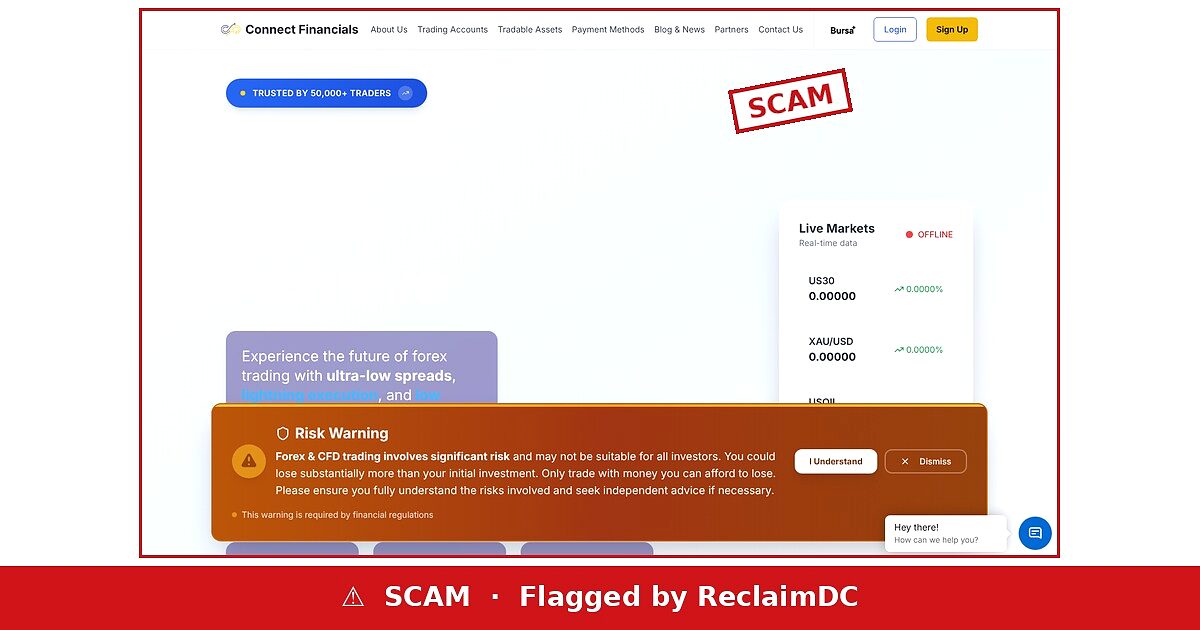
Connect Financials offers forex and CFD trading at connectfinancials.com and says it is “trusted by 50,000+ traders”. The Cyprus Securities and Exchange Commission warned about the site on 16 April 2026, as recorded on IOSCO’s I-SCAN database. The site was still live in November.
The licence it shows
The footer reads “Connect Financials Ltd. | Registered in Seychelles | License: SD244” and says the firm “is authorized and regulated by the Seychelles Financial Services Authority (SFSA)”. It also offers “No minimum deposit” and a $10,000 demo account. The domain itself dates back to 2017.
An offshore licence, even a real one, does not allow a firm to sell to clients in Cyprus or the rest of the EU. CySEC’s warning means the firm is not authorised to offer investment services there. Check the Seychelles FSA register yourself and confirm the licence number belongs to this exact website.
Verified evidence
- CySEC warning on connectfinancials.com, 16 April 2026, via IOSCO I-SCAN
- Claims “Connect Financials Ltd”, Seychelles, “License: SD244”
- “Trusted by 50,000+ traders”
- “No minimum deposit” and $10,000 demo funds
- Domain registered 1 June 2017
If you trade there
- Request a withdrawal now and keep a record of the reply.
- Never pay a tax, fee or “insurance” before a withdrawal.
- Save statements, chat logs and payment receipts.
- Report card and bank payments to your bank.
- Report to CySEC or your national regulator.
An offshore licence is not permission to sell to you. If Connect Financials holds your money, email support@reclaimdc.com.
“FSCS Protected” from Seychelles
The site lists its office as 302, House of Francis, Ile du Port, English River, Mahe, Seychelles, and shows a badge reading “FSCS Protected: Client funds protected”. The FSCS is the UK’s Financial Services Compensation Scheme. It covers customers of firms authorised in the UK, not companies registered in Seychelles. A Seychelles firm claiming UK compensation cover is claiming something that cannot apply to it.
Connect Financials runs English and Arabic Facebook and Instagram accounts, a TikTok, and a WhatsApp channel offering “daily market analysis, trading signals, and exclusive insights”. Signal channels on messaging apps are a common route from social media into trading accounts.
The domain itself dates from 2017, but age is not authorisation.
How to check a CySEC warning yourself
CySEC keeps a public register of Cyprus Investment Firms, each with a licence number and a list of approved websites. Search for the company and check that the web address appears on its entry. An offshore licence from outside the EU does not let a firm sell investment services to EU residents. Check any claimed offshore licence on that regulator’s own register too. Report the site to CySEC and your national regulator.
How these schemes usually play out
Sites like this usually follow the same steps. First comes an advert, a social media message or a phone call. Then a small first deposit, often a few hundred dollars or euros. A dashboard soon shows fast profits, and an “account manager” pushes for a bigger deposit. When you try to withdraw, new fees appear: tax, insurance, verification or “unlocking” charges. Paying them never releases the money. At that stage, stop paying, keep every record, and report what happened.
Keep screenshots of the dashboard and your balance, the website address, every email and chat, phone numbers that called you, and every bank, card or crypto payment with dates and amounts. For crypto, keep the wallet addresses and transaction hashes. These records are what your bank, the police and the regulator will ask for first.
If you already paid
- Call your bank today, tell them you have paid a fraudulent investment site and ask them to try to recall the payment.
- If you paid by card, ask about a chargeback.
- Change any passwords you shared and remove any remote-access app the caller asked you to install.
- Do not send ID documents or selfies to anyone connected with the site.
- Report the site to the regulator named above and to the police.
- Be wary of anyone who contacts you offering to recover the funds for an upfront fee.
Sources: CySEC alert on connectfinancials.com, 16 April 2026, via IOSCO I-SCAN (iosco.org); RDAP record (1 June 2017); connectfinancials.com captured 17 November 2026.