
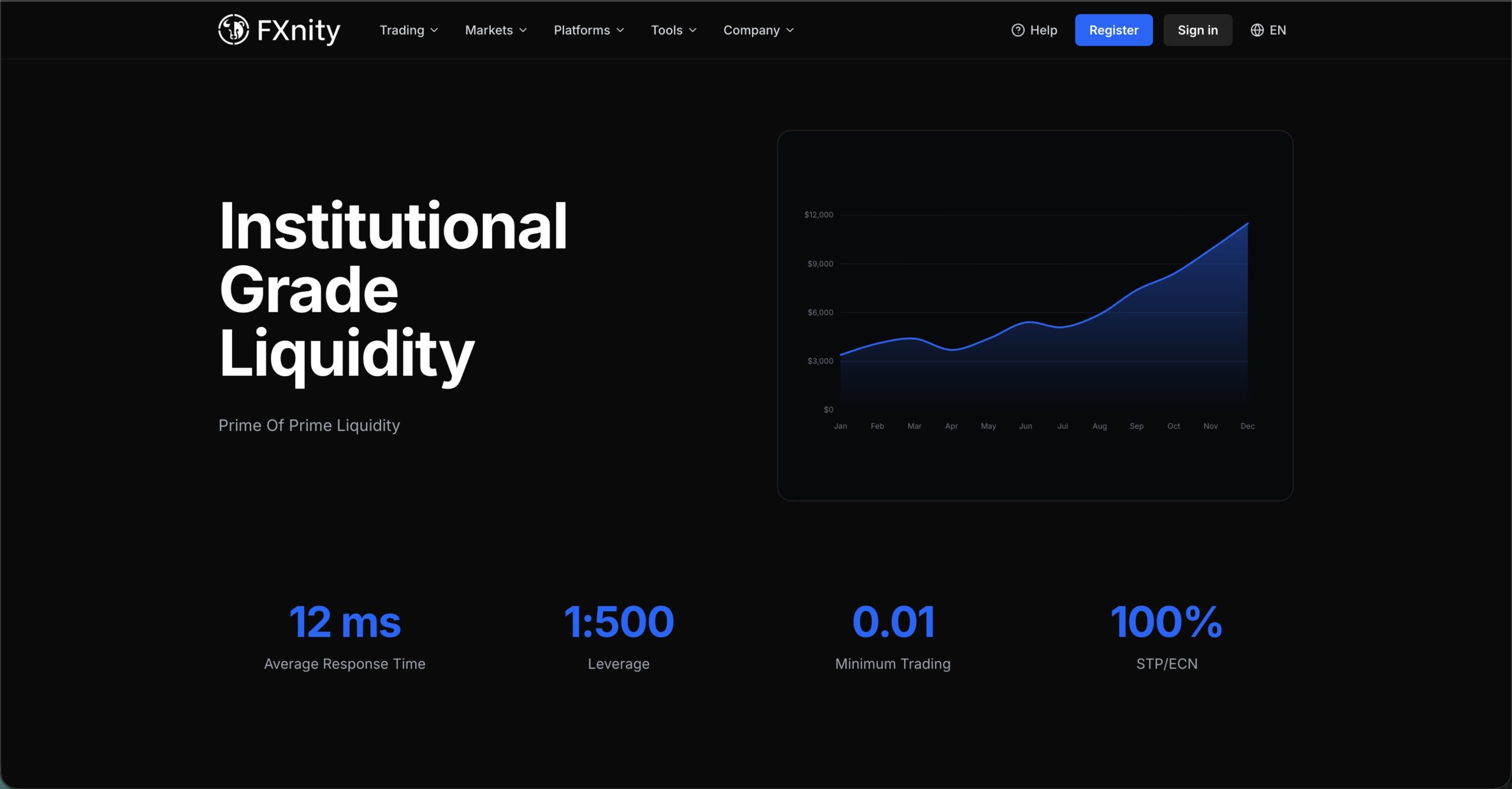
FXnity (fxnity.com) is an online forex and CFD trading platform that markets itself as an “institutional-grade ECN/STP broker” offering ultra-fast execution, tight spreads, high leverage, and access to forex, indices, commodities, stocks, and crypto CFDs.
At surface level, the platform looks modern and professional. But when you move past the marketing language and examine regulatory status, transparency, and independent risk signals, FXnity raises several concerns that traders should understand before depositing funds.
This review breaks down the key risks surrounding FXnity, including regulation gaps, withdrawal uncertainty, execution claims, and overall trust signals.
What Is FXnity?
FXnity is a forex and CFD broker offering trading services across:
- Forex currency pairs
- Commodities and metals
- Indices
- Stocks (CFDs)
- Cryptocurrency CFDs
The platform promotes features such as:
- STP/ECN execution model
- Leverage up to 1:500
- Low minimum deposits
- Fast execution (claimed ~12ms)
- Multi-asset trading environment
While these claims sound competitive, marketing claims alone do not establish safety or regulatory credibility.
Warning Sign #1: Weak Regulatory Protection Structure
One of the biggest concerns around FXnity is its regulatory situation.
Independent analysis shows FXnity is registered under an offshore-style licensing structure (MISA in Comoros), which is not considered a Tier-1 financial regulator.
This matters because offshore-style oversight typically means:
- No strong investor compensation scheme
- Limited enforcement power in disputes
- Weaker audit and capital requirements
- Reduced protection if the broker becomes insolvent
In practical terms, traders are relying heavily on the broker’s internal policies rather than enforceable financial regulation.
Warning Sign #2: High Risk Classification in Independent Reviews
Independent broker analysis platforms flag FXnity as high-risk due to weak transparency and regulatory limitations.
Key findings include:
- Lack of verifiable management details
- Limited corporate transparency
- No strong regulatory database presence
- Marketing-heavy positioning without strong legal disclosures
Some watchdog-style reviews go further, categorizing FXnity as potentially unsafe due to its structural risk profile and unclear accountability framework.
This does not automatically prove fraud, but it is a serious warning signal in broker evaluation.
Warning Sign #3: Regulatory Claims vs Reality Gap
FXnity presents itself as a global institutional broker, but independent checks show:
- No Tier-1 regulation (FCA, ASIC, CySEC)
- No publicly verifiable investor protection framework
- No strong audit disclosures
Instead, it relies on offshore registration plus marketing language like “institutional liquidity” and “prime execution.”
This gap between branding and verifiable oversight is a common risk pattern in high-risk CFD brokers.
Warning Sign #4: Mixed User Feedback and Early Trust Signals
User reviews are mixed but limited in depth.
Positive feedback highlights:
- Fast execution
- Smooth onboarding
- Responsive support
- Quick deposits and withdrawals (in early-stage reviews)
However, limited review volume is itself a concern.
A small sample size means:
- Easier manipulation of reputation
- Lack of long-term withdrawal testing
- No evidence of performance during stress events
Early positive feedback does not guarantee long-term reliability.
Warning Sign #5: Scam-Score Algorithms Flag Risk
Automated trust-scoring systems classify FXnity as low-trust or high-risk due to:
- Young domain age
- Low traffic rank
- Crypto/CFD risk classification
- Limited transparency signals
These systems are not definitive proof, but they are designed to detect patterns commonly seen in unreliable financial websites.
When multiple risk indicators align, caution becomes necessary.
Warning Sign #6: Lack of Corporate Transparency
Independent investigations highlight missing or unclear details such as:
- No clearly verified executive team
- Limited corporate background information
- Unclear physical office structure
- Weak public financial disclosures
For financial platforms handling client funds, transparency is not optional—it is a core trust requirement.
When it is missing, accountability becomes difficult if disputes arise.
Warning Sign #7: High-Leverage Trading Model Risk
FXnity offers leverage up to 1:500, which significantly increases trading risk.
High leverage does not indicate fraud, but it does amplify:
- Account liquidation risk
- Emotional overtrading
- Rapid capital loss
- Margin sensitivity during volatility
This is especially dangerous for inexperienced traders who misunderstand risk exposure.
Common Risk Pattern to Understand
FXnity fits a common structure seen in high-risk CFD brokers:
- Attractive marketing (low spreads, fast execution)
- Easy onboarding and deposits
- Early smooth trading experience
- Limited regulatory clarity
- Uncertain long-term withdrawal track record
- Heavy reliance on internal compliance rules
This pattern does not prove wrongdoing, but it is widely observed in brokers that later develop trust issues.
How Traders Can Protect Themselves
Before using FXnity or similar brokers:
Verify Regulation Directly
Check regulatory claims in official databases—not marketing pages.
Start With Minimal Funds
Avoid large deposits until withdrawal reliability is proven.
Test Withdrawals Early
Withdraw small amounts before scaling trading activity.
Keep Full Records
Document deposits, trades, and communication with support.
Avoid Overleveraging
High leverage increases risk of total account loss.
Final Verdict: High-Risk Broker With Weak Regulatory Strength
FXnity is not definitively proven to be a scam, but it operates in a high-risk category due to weak regulatory oversight, limited transparency, offshore-style licensing structure, and early-stage trust signals.
The biggest concern is not immediate failure—it is lack of strong investor protection and limited long-term verification under real trading stress conditions.
Until FXnity demonstrates Tier-1 regulation, stronger transparency, and a long-term withdrawal track record, it should be treated as a high-risk speculative trading platform.
For safety-focused traders, caution is essential, and exposure should remain minimal.