
Verdict up front: Zescapital (zescapital.com) is a brand-new CFD site soliciting deposits with no disclosed regulation and none of the basic corporate details a real broker publishes, and it is flagged on the BrokersView watchdog list. On the evidence available, treat it as high-risk and keep your money out.
Verified evidence (checked 25 August 2026)
Watchdog warning: BrokersView lists Zescapital as Unregulated (Abnormal Warning) — its site provides no regulatory disclosures and fails to list basic corporate information such as legal entity, registered address, jurisdiction, or contact details.
Domain age: registered only about five weeks before it was recorded — no track record.
Regulation: the live site advertises multi-asset CFD trading and takes deposits, yet shows no licence number, regulator, or jurisdiction.
Sources: BrokersView scam list (zescapital.com); domain registration records.
RELATED INVESTIGATION Why brand-new CFD sites with no licence are high-risk. | INVESTORS, TAKE NOTE No regulator named = no protection if funds vanish. | READ THIS BEFORE YOU INVEST Demand a licence number and verify it before depositing. |
What is Zescapital?
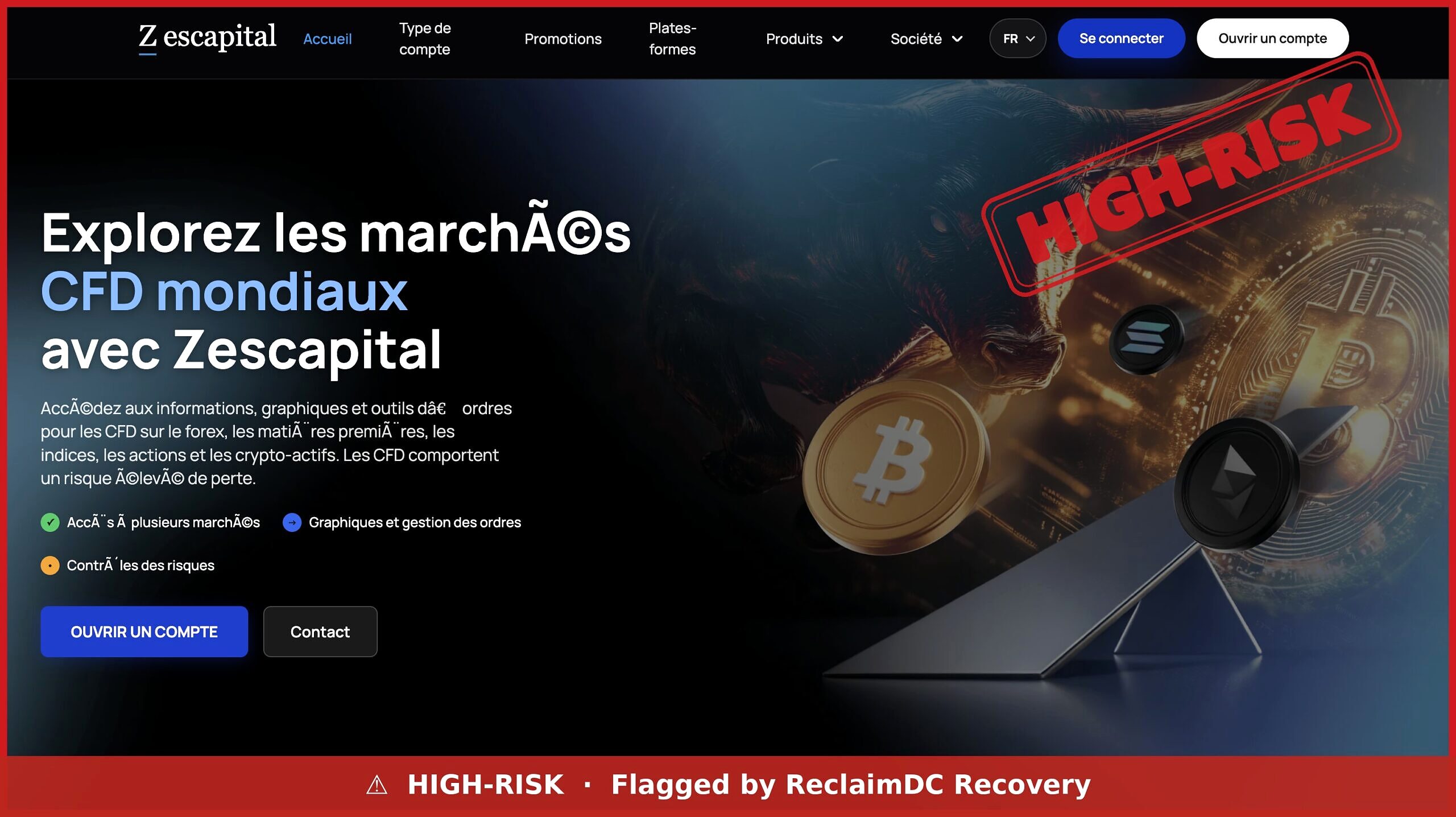
Zescapital presents itself as a gateway to “global CFD markets,” with slick, multi-language pages advertising forex, commodities, indices, shares and crypto-assets. What it does not present is the one thing that matters most before you hand over a deposit: who, if anyone, regulates it. When the watchdog BrokersView reviewed the site it found no regulatory disclosures and none of the standard corporate information — the legal entity behind the platform, a registered office, the jurisdiction it operates under, or verifiable contact details. A platform that actively takes client deposits while withholding all of that is asking for trust it has done nothing to earn.
Why the age of the site is a red flag
Domain records show Zescapital was registered only about five weeks before it was recorded on the watchdog list. That matters because a legitimate broker’s credibility is built over years — regulatory approvals, audited accounts, a verifiable trading history, and a reputation that can be checked. A site that is barely a month old but already positioning itself as an established “global” platform is a mismatch worth pausing on. Many short-lived operations follow a predictable arc: launch a professional-looking site, run aggressive marketing, collect deposits, obstruct withdrawals, and then disappear — often re-emerging later under a new name and domain. Youth alone does not prove wrongdoing, but combined with no regulation and no corporate transparency, it removes every reassurance you would normally rely on.
What real regulation would give you
The reason a licence number matters is not bureaucracy — it is protection. A broker authorised by a serious regulator (the FCA in the UK, CySEC in the EU, ASIC in Australia, and similar) must keep client money in segregated accounts, meet capital requirements, follow conduct rules, and give you access to a formal complaints and dispute process; some regimes add an investor-compensation scheme if the firm collapses. Zescapital shows none of this. Without a named regulator, there is no rulebook it answers to and no authority you can escalate to if your withdrawal is refused.
How to check it yourself before depositing
Never rely on a claim printed on the broker’s own website. Ask directly for the operating entity’s name and its licence number, then verify that number on the regulator’s official public register — the details must match exactly. Confirm a genuine registered address and company number you can look up independently. Check the domain’s registration date. And treat any of these as decisive warning signs: no licence number offered, a licence that doesn’t match on the register, pressure to deposit before you have verified anything, or account managers steering you toward larger deposits.
If you have already deposited
If funds are already with Zescapital, stop sending more — particularly any “fee,” “tax,” or “verification payment” demanded before a withdrawal, which is a classic advance-fee trap. Save every record: statements, receipts, chat and email logs, and the names used by anyone who contacted you. Contact your bank or card provider quickly about a chargeback or payment recall, since deadlines apply, and report the firm to your national regulator. Fast action and clean documentation give you the best chance of recovering something.
Protect yourself
Don’t deposit into an unregulated, newly-launched platform. Check it yourself — search on Google, ask ChatGPT, and view the site: zescapital.com.
The bottom line
No single red flag proves fraud on its own, but the combination here is what matters: an unregulated platform, missing or unverifiable regulation, and a watchdog warning all pointing the same way. A legitimate, well-run broker makes its licence effortless to check and its corporate identity easy to confirm. When those basics are absent and a site is still asking for your deposit, the safest assumption is the cautious one. If in doubt, keep your money where it is protected and walk away — there will always be another, properly regulated option to consider instead.
Reviewed by ReclaimDC Editorial. Methodology & Editorial Standards apply. Corrections: support@reclaimdc.com.
Sources: BrokersView scam list (zescapital.com); domain registration records; FCA/CySEC public registers.