
Verdict up front: Bucksa (bucksa.com) markets “institutional trading infrastructure” in a “Regulated Trading Environment”, “governed by regulatory discipline”. It names no regulator. Australia’s regulator ASIC put it on its investor alert list on 24 September 2026, published on IOSCO’s I-SCAN. Do not open an account.
Bucksa
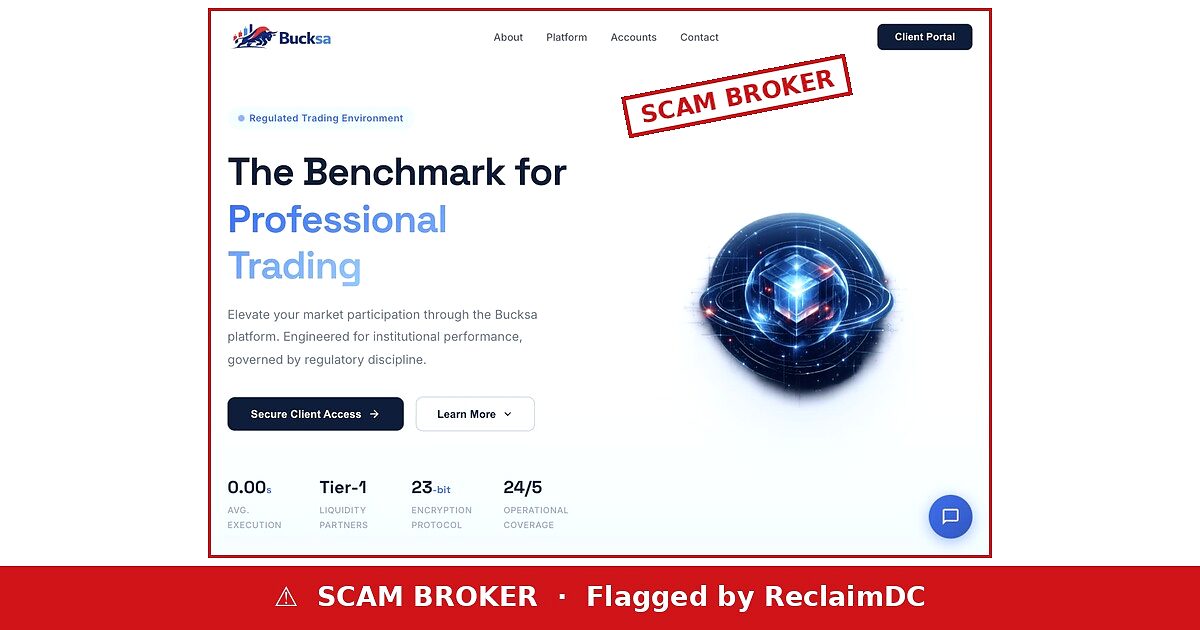
bucksa.com · “The Benchmark for Professional Trading”
SCAM BROKER
- Website
- bucksa.com
- Domain registered
- 24 October 2010 — an old domain now carrying a new trading brand
- Regulator
- ASIC investor alert, 24 September 2026 (via IOSCO I-SCAN)
- Registrar
- NameCheap, Inc.
- Status
- Live — page loads today
Institutional words, no institution
The badge at the top reads “Regulated Trading Environment”. The copy talks about “Tier-1 liquidity partners”, “institutional-grade encryption” and “a regulated environment designed for participants who demand immediate execution”. No liquidity partner, no regulator, no licence and no company number is named. Two five-star quotes come from “David D., Institutional Trader” and “Charlotte L., Senior Market Analyst” — initials only.
The stats strip
Under the headline, four figures: “0.00s” average execution, “Tier-1” liquidity, “23-bit encryption protocol” and “24/5” coverage. Elsewhere the same page says 256-bit. Zero-second execution does not exist.
London and Australia at once
The contact block gives 5 Broadgate, London EC2M 2QS — a large City office building — with a UK number, +44 2046 542734, and an Australian mobile number beginning +61 4. ASIC’s alert suggests the Australian line is aimed at Australian customers. The domain itself dates from 2010, which makes the brand look older than it is.
⚠ Verified evidence
- ASIC listed Bucksa (bucksa.com) on 24 September 2026 (IOSCO I-SCAN).
- The site claims a “Regulated Trading Environment” but names no regulator or licence.
- Its stats strip shows “0.00s” execution and “23-bit” encryption.
- It lists a London Broadgate address with UK and Australian phone numbers.
- bucksa.com was first registered on 24 October 2010.
Did Bucksa cost you money or time?
Tell us what happened. One email starts it — no form, no phone call, no fee.
✎ File a complaint about BUCKSA
Or write to us directly: support@reclaimdc.com
Include the website, any amount you paid, and screenshots if you have them. Never send passwords, private keys or seed phrases.
How to verify Bucksa in two minutes
Search ASIC’s Professional Register on Moneysmart, which lists AFS licence holders for both “Bucksa” and bucksa.com — a licensed firm turns up under each. A WHOIS or RDAP lookup on bucksa.com shows the registration date: 24 October 2010 an old domain now carrying a new trading brand. An Australian licence has a six-digit AFSL number you can search in seconds. A match on name alone is not enough — the website on the entry must be bucksa.com.
The verdict: Bucksa talks like an institution, names no regulator, shows impossible statistics, and is on ASIC’s alert list. Do not deposit.
Sources, checked 27 September 2026: IOSCO I-SCAN entry “Bucksa (bucksa.com)” — Australia, ASIC, 24 September 2026 · RDAP registration record for bucksa.com · the live page at bucksa.com, read in full
Rechecked on 17 November 2026
On 17 November 2026 visitors to bucksa.com were stopped by a Cloudflare “Suspected Phishing” warning, which says the site “has been reported for potential phishing”. The domain bucksa.com was registered on 24 October 2010.
How to check an ASIC warning yourself
Search the business or website name on ASIC’s professional registers through ASIC Connect, and check Moneysmart’s investor alert list, which includes the sites ASIC has flagged. A real Australian Financial Services licensee can be found by its licence number and legal name, and the contact details on the register should match the website you are on. If they do not, treat the site as a clone. Losses can be reported to ASIC and to Scamwatch, and card or bank payments should be reported to your bank as fraud straight away.
Phishing sites collect more than deposits. They gather passwords, email addresses, phone numbers and copies of passports or driving licences uploaded for “verification”. If you used this one, change any password you reused elsewhere, turn on two-factor authentication for your email and bank, and watch for unexpected accounts or credit applications in your name.
If you already paid
- Call your bank today, tell them you have paid a fraudulent investment site and ask them to try to recall the payment.
- If you paid by card, ask about a chargeback.
- Change any passwords you shared and remove any remote-access app the caller asked you to install.
- Do not send ID documents or selfies to anyone connected with the site.
- Report the site to the regulator named above and to the police.
- Be wary of anyone who contacts you offering to recover the funds for an upfront fee.