
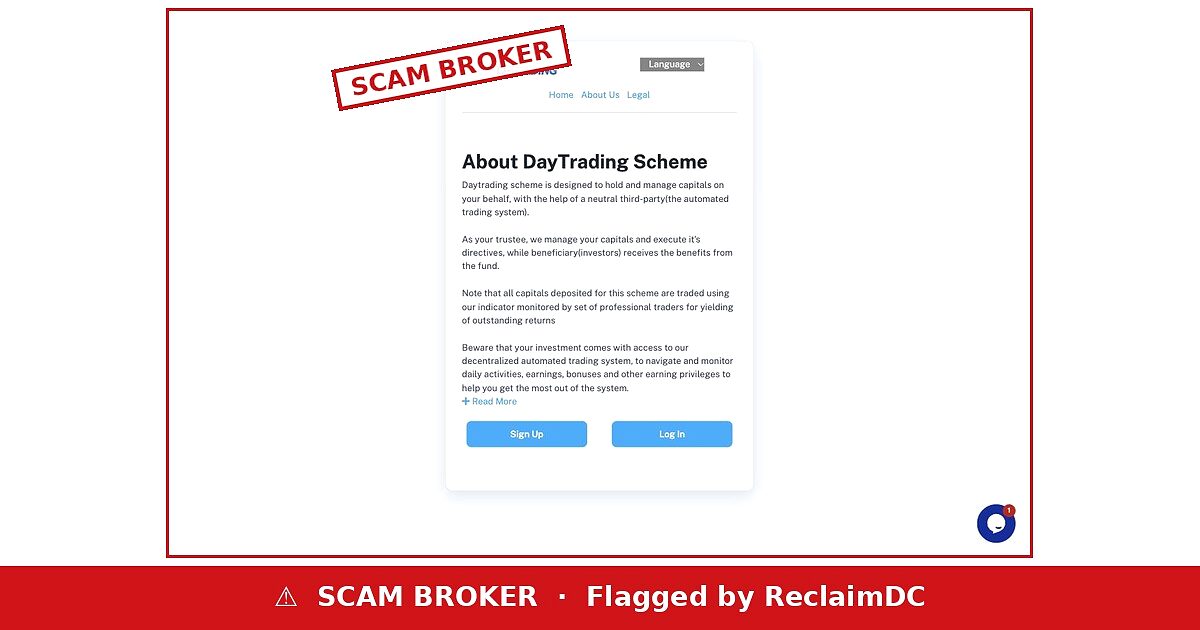
D-Trading, running as the “DayTrading Scheme” (daytradingschemes.com), says it is “designed to hold and manage capitals on your behalf” and acts “as your trustee”. Australia’s regulator ASIC warned about it on 5 August 2026. The domain was registered on 2 March 2026.
D-Trading
daytradingschemes.com
SCAM BROKER
- Website
- daytradingschemes.com
- Brand
- D-Trading / DayTrading Scheme
- Role claimed
- Trustee holding and managing investors’ capital
- Promise
- “Outstanding returns”, daily earnings and bonuses
- Warning
- ASIC (Australia), 5 August 2026
- Domain registered
- 2 March 2026 — about 7 months old
Trustee without a licence
“As your trustee, we manage your capitals and execute its directives, while beneficiary (investors) receives the benefits from the fund.” Holding other people’s money as a trustee and running a fund are among the most heavily licensed activities in finance. D-Trading names no licence for either, and ASIC has warned about it.
The ‘neutral third party’
The site says your money is managed “with the help of a neutral third-party (the automated trading system)”. A trading program is not a third party. The phrase borrows the language of escrow to suggest safety that does not exist.
⚠ Verified evidence
- ASIC warning about daytradingschemes.com, 5 August 2026.
- Calls itself a scheme and a trustee.
- “Outstanding returns” with no strategy shown.
- Domain registered 2 March 2026.
Did D-Trading cost you money or time?
Tell us what happened on our short complaint form — it goes straight to our support team, nothing to download, and we reply personally.
✎ File a complaint about D-Trading
Include the website, the dates, the amounts and how you paid. Screenshots help.
Outstanding returns, by indicator
“All capitals deposited for this scheme are traded using our indicator monitored by set of professional traders for yielding of outstanding returns.” No indicator, trader, strategy or past result is shown. The promise is the product.
Earnings, bonuses and privileges
Members get access to “daily activities, earnings, bonuses and other earning privileges”. Daily earnings shown in a dashboard are how these schemes keep people depositing: the numbers grow on screen until a withdrawal is requested.
If money has gone to D-Trading
Do not pay any “tax”, “unlock” or “verification” fee D-Trading asks for — those charges never release a balance. If D-Trading had you install screen-sharing software, delete it and run a security scan. Reset your email and banking passwords if D-Trading ever saw your screen.
- Ask your bank’s fraud team to recall the payment to D-Trading and to flag the receiving account.
Where D-Trading should appear — and does not
The quickest test is ASIC’s Professional Register on Moneysmart, which lists AFS licence holders: search “D-Trading” and, separately, daytradingschemes.com. Then compare the domain date (2 March 2026) with the history the site claims. An Australian licence has a six-digit AFSL number you can search in seconds. If you are outside ASIC’s country, check your own regulator as well.
The verdict: D-Trading asks to hold your money as a trustee without the licence that job requires. Do not deposit.
Sources, checked 3 October 2026: ASIC (Australia) warning via IOSCO I-SCAN (5 August 2026) · RDAP registration record for daytradingschemes.com · the live page at daytradingschemes.com, read in full. Warnings come from regulators, not courts. General information, not investment advice.
Rechecked on 17 November 2026
On 17 November 2026 daytradingschemes.com was still online, under the page title “Home-Day Trading Scheme”. The domain daytradingschemes.com was registered on 2 March 2026.
How to check an ASIC warning yourself
Search the business or website name on ASIC’s professional registers through ASIC Connect, and check Moneysmart’s investor alert list, which includes the sites ASIC has flagged. A real Australian Financial Services licensee can be found by its licence number and legal name, and the contact details on the register should match the website you are on. If they do not, treat the site as a clone. Losses can be reported to ASIC and to Scamwatch, and card or bank payments should be reported to your bank as fraud straight away.
If you already paid
- Call your bank today, tell them you have paid a fraudulent investment site and ask them to try to recall the payment.
- If you paid by card, ask about a chargeback.
- Change any passwords you shared and remove any remote-access app the caller asked you to install.
- Do not send ID documents or selfies to anyone connected with the site.
- Report the site to the regulator named above and to the police.
- Be wary of anyone who contacts you offering to recover the funds for an upfront fee.