
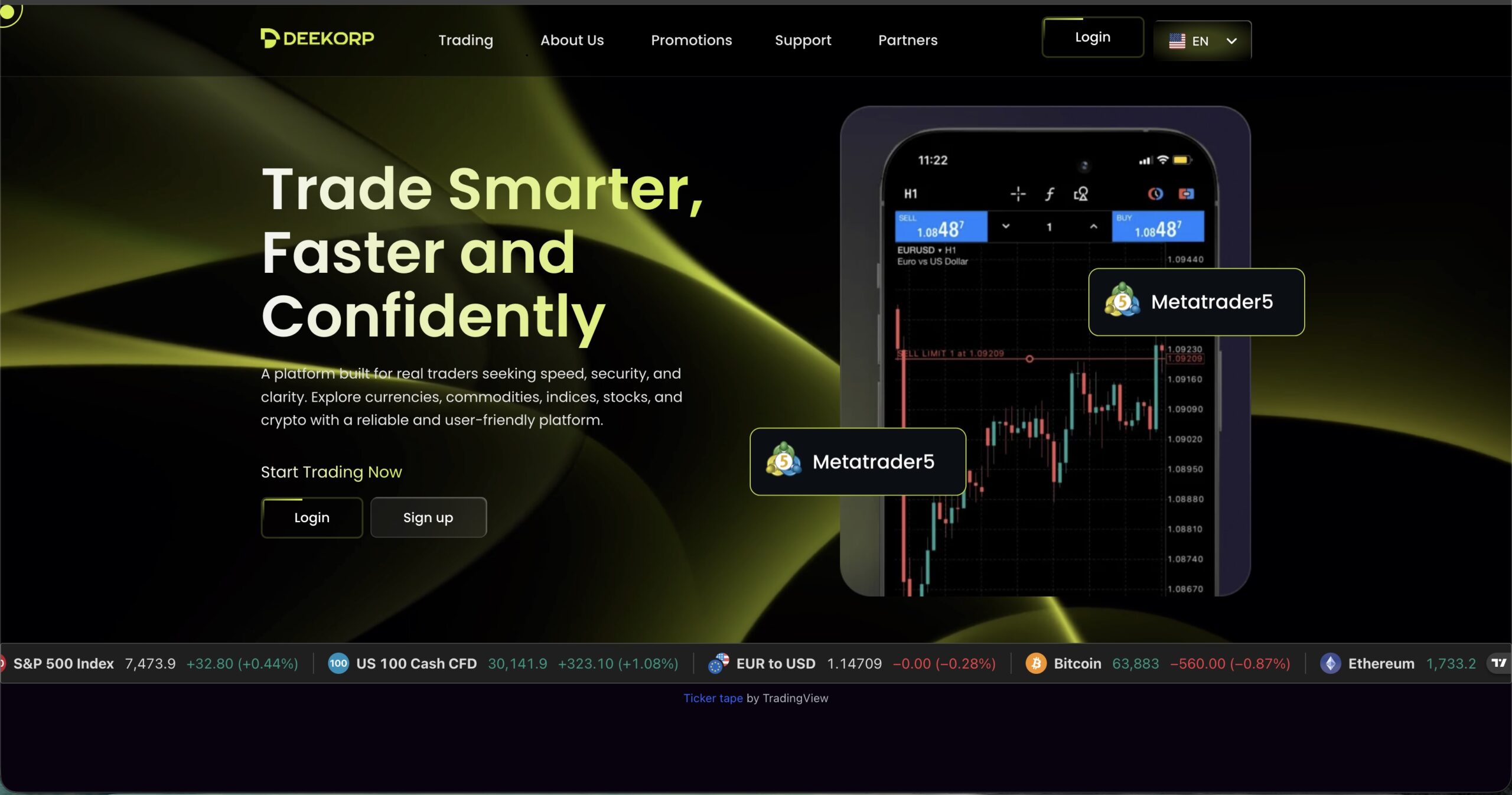
Deekorp presents itself as a forex and investment trading platform offering access to global markets, account management services, and “high-yield trading strategies.” On the surface, it follows the familiar template of modern offshore brokers targeting retail investors.
But when you strip away the marketing language and examine regulatory status, transparency, and operational behavior patterns, Deekorp fits a high-risk unregulated broker profile with multiple scam-style indicators commonly flagged in offshore trading schemes.
Regulatory Reality: No Verifiable Financial Authorization
The first and most important checkpoint is regulation.
Deekorp does not show evidence of authorization from top-tier financial regulators such as:
- FCA (UK)
- ASIC (Australia)
- CySEC (EU)
- SEC/FINRA-linked oversight frameworks
Instead, it appears in broker risk databases as an unregulated entity with scam risk classification signals due to lack of licensing transparency and investor protection structure.
That matters because regulation is not branding—it is legal enforceability.
Without it:
- No guaranteed fund protection
- No external dispute resolution
- No compensation scheme for losses
- No enforceable oversight on withdrawals
Structural Red Flag: Transparency Deficiency
Legitimate brokers are required to clearly disclose:
- Registered legal entity name
- Physical headquarters
- License number and regulator
- Compliance officer details
- Custody and fund segregation structure
Deekorp-type platforms typically fail in one or more of these areas, especially:
- Missing or unclear corporate registration
- No verifiable regulator license ID
- Offshore-style operational presentation
- Limited ownership transparency
When identity cannot be independently verified, accountability becomes untraceable.
Withdrawal Risk Pattern: The Key Failure Point
Across unregulated broker ecosystems, the most consistent risk is not trading—it is withdrawal behavior.
Common reported patterns include:
- Withdrawal requests stuck in “processing” status indefinitely
- Sudden “compliance checks” after profit attempts
- Requests for additional fees (tax, clearance, verification)
- Account restrictions during large withdrawal requests
- Customer support delays or scripted responses
The underlying structure is predictable:
Deposits are easy → trading appears functional → withdrawals become conditional
That imbalance is the core warning signal.
Artificial Performance Environment Risk
Platforms like Deekorp often rely on trading dashboards that:
- Show continuous account growth
- Display simplified profit metrics
- Create the impression of stable returns
- Encourage reinvestment instead of withdrawal
The key issue is not whether numbers appear real—it is whether they are independently verifiable through audited execution and external liquidity sources.
Without audit transparency, performance data is not proof—it is presentation.
Psychological Manipulation Layer
High-risk broker systems typically rely on structured behavioral influence:
- Early small wins to build confidence
- Account managers increasing pressure for deposits
- “Limited-time opportunity” messaging
- Bonus offers tied to larger capital deposits
- Emotional reinforcement through profit visuals
This creates a controlled decision environment where users gradually increase exposure before realizing withdrawal friction exists.
Offshore Structure Risk: Weak Legal Enforcement
Deekorp-style brokers often operate through offshore incorporation models.
The issue is not offshore registration itself—it is lack of enforceable financial regulation in those jurisdictions.
This leads to:
- Weak investor protection laws
- No effective financial dispute system
- Difficulty pursuing legal recovery
- Limited oversight of broker conduct
In practice, offshore structure often means reduced accountability, not increased flexibility.
Liquidity and Custody Transparency Concerns
Legitimate brokers provide:
- Proof-of-reserves
- Segregated client fund verification
- Independent audits
- Clear custody partners
Deekorp-type platforms typically lack:
- Verified reserve audits
- Transparent custody disclosures
- Third-party financial verification
- Institutional banking clarity
Without custody transparency, users cannot confirm whether funds are actually held in segregated accounts.
Scam Risk Pattern Classification
Deekorp aligns with several high-risk broker indicators commonly used in scam classification models:
- No Tier-1 regulatory license
- Offshore or unclear registration structure
- Withdrawal friction risk reports in similar broker categories
- Marketing claims exceeding verifiable proof
- Weak transparency in corporate identity
- Dependence on internal account control systems
When multiple indicators cluster, risk is not theoretical—it becomes structural.
Stress Test Questions You Must Ask
Before trusting any platform like Deekorp, force clarity on:
- Which regulator has legal authority over this company?
- Can the license be verified in an official registry?
- Who legally holds custody of deposited funds?
- What happens if I request full withdrawal immediately?
- Is trading execution independently audited and verifiable?
If answers are vague, delayed, or non-verifiable, that is already a conclusion.
Why “Working Platform” Is Not Safety Proof
A critical mistake investors make is assuming:
“If I can deposit and trade, the platform must be legitimate.”
But functionality is not proof of safety.
Unregulated platforms can:
- Operate normally for months
- Show simulated or partial trading functionality
- Process small withdrawals initially
- Maintain professional dashboards
Risk often appears only during large withdrawal events or profit realization attempts.
That is when structural weaknesses are exposed.
Final Assessment: Why Deekorp Is High-Risk
Deekorp fits a consistent pattern seen in unregulated broker environments:
- No verifiable top-tier financial regulation
- Offshore-style structural setup
- Withdrawal friction risk indicators
- Limited transparency in corporate identity
- Dependence on internal control systems
- Marketing-driven investment framing
These factors create a system where user trust replaces legal protection.
That is the central vulnerability.
Stay-Away Conclusion
The real issue is not whether Deekorp can show trading activity or account growth.
The issue is whether those gains can be reliably and legally withdrawn under independent oversight.
There is no strong evidence of that protection.
When regulation is absent and withdrawal control remains internal, the system is not a financial institution—it is an exposure environment with no guaranteed exit protection.
The rational position is simple:
If regulation cannot be independently verified and withdrawals are not enforceable under external authority, capital exposure should be avoided entirely.