
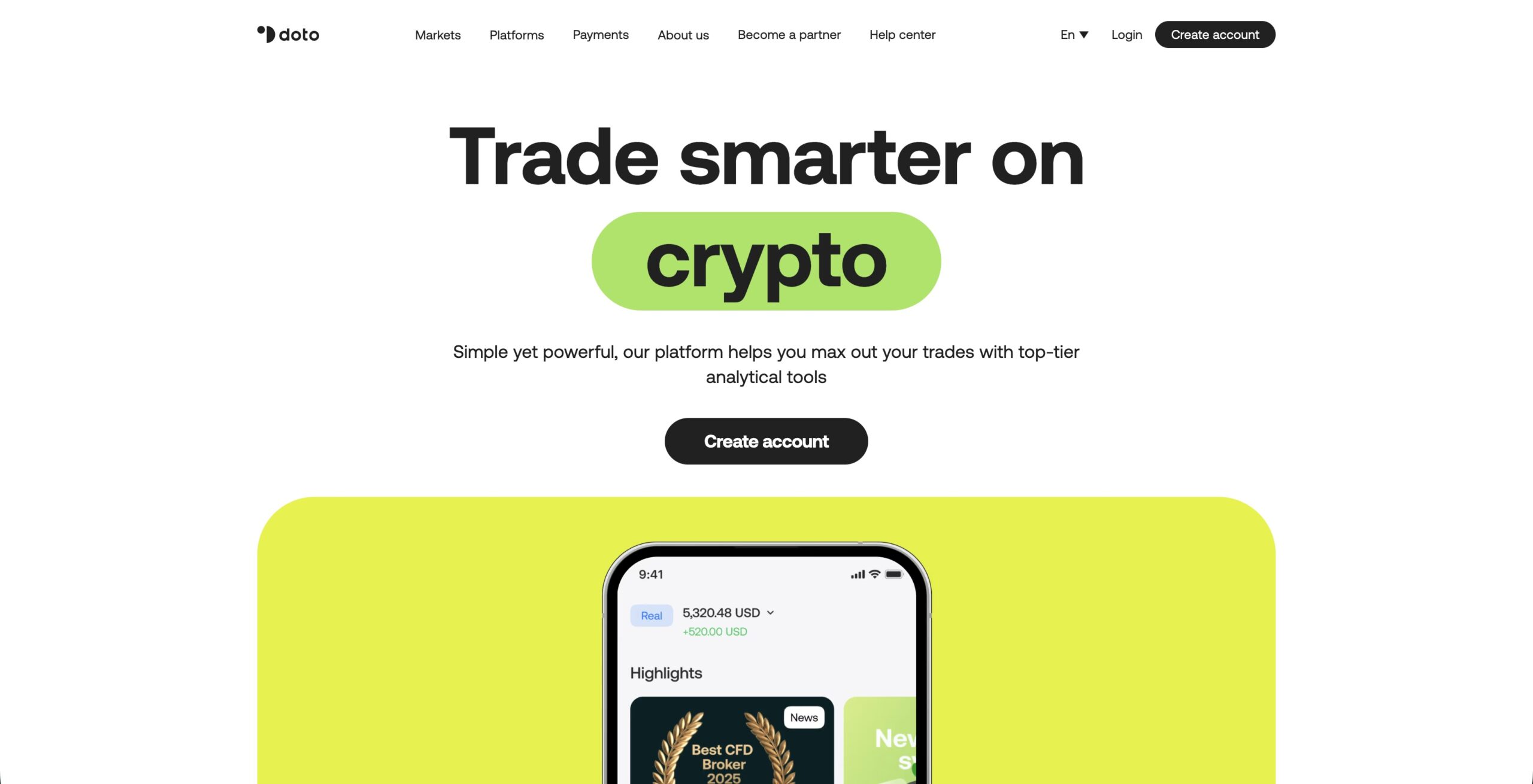
When analyzing https://doto.com, the key mistake is assuming that “regulated + popular + active reviews” automatically equals safety. Doto is a globally marketed CFD broker with strong branding, regulatory claims, and a large user base—but also a highly divided complaint profile around withdrawals, account restrictions, and trading execution disputes.
This report breaks down regulation reality, withdrawal risk signals, trust contradictions, and structural broker behavior patterns tied to Doto.com.
1. Trust Signal Reality: Legitimate but Contested
Independent analysis shows a mixed but generally mid-risk profile:
- Scam Detector assigns a high trust score (~86/100) and classifies it as relatively safe in general terms
- ScamAdviser flags concerns like hidden ownership, low traffic, and crypto exposure risks
- Long domain history and SSL security are present, which are positive baseline signals
At the same time, Trustpilot reviews show serious contradictions:
- Some users report smooth deposits, withdrawals, and usable trading tools
- Others report blocked withdrawals, seized funds, and sudden account restrictions
This split is not random.
It usually indicates a platform where user experience depends heavily on account behavior, region, or withdrawal stage.
2. Regulation Structure: Licensed, But Not Uniform Protection
Doto claims regulation under multiple jurisdictions including:
- CySEC (EU structure via Mauritius-linked entity)
- FSCA (South Africa)
- FSC (Mauritius-style offshore structure)
This creates a key structural reality:
Different users may fall under different legal entities depending on region.
That matters because:
- EU-regulated clients typically have stronger protections (ICF coverage, stricter compliance)
- Offshore entity clients may face weaker dispute resolution paths
- Withdrawal enforcement varies by jurisdiction
So while Doto is not an unregulated broker, it is a multi-entity broker with uneven protection levels.
And that creates structural inconsistency in client outcomes.
3. Withdrawal Complaints: The Core Risk Signal
Across user reviews, the most important friction point is not trading—it is withdrawal behavior under stress conditions.
Reported issues include:
- Funds being “frozen” or restricted after minimal trading activity
- Account reviews triggered during withdrawal attempts
- Delays tied to compliance or verification checks
- Claims of unclear justification for blocking access to funds
- Slippage and execution concerns affecting profitability outcomes
Even the broker’s responses confirm a key pattern:
Withdrawals may be delayed due to compliance or account review procedures.
Now here is the critical interpretation:
Compliance checks are normal in regulated finance.
But timing matters more than existence.
If checks intensify mainly when users try to withdraw profits, then compliance becomes a control layer rather than a neutral process.
4. The “Account Review After Profit” Pattern
A recurring behavioral sequence appears across user complaints:
- Account opens and deposits are accepted normally
- Trading platform functions without restriction
- Small withdrawals may succeed
- Profit increases or larger withdrawal is requested
- Account enters “review” or “verification” stage
- Funds become delayed or restricted
Common explanations include:
- “Execution review due to market conditions”
- “Compliance verification under Client Agreement”
- “Trading pattern assessment”
- “Liquidity or risk controls”
Individually, these are standard brokerage mechanisms.
But structurally, the concern is:
Enforcement intensity increases at exit stage, not entry stage.
That asymmetry is where user trust breaks down.
5. Trustpilot Conflict: Two Realities Coexisting
Doto’s Trustpilot ecosystem shows a split personality effect:
Positive side:
- Fast deposits and withdrawals for some users
- Functional trading platform (MT4/MT5 support)
- Responsive customer support in many cases
Negative side:
- Allegations of seized funds without clear explanation
- Claims of blocked withdrawals
- Complaints about slippage affecting trading outcomes
- Perception of unfair account restrictions
This duality is important.
It suggests the platform is not uniformly behaving as either “safe” or “unsafe”—instead it is conditional based on context.
That is often more dangerous than clear-cut fraud patterns because it reduces predictability.
6. Broker Structural Reality: Market Maker Conflict Risk
User complaints also include accusations that Doto operates as a B-book broker (market maker model) where:
- The broker may take the opposite side of client trades
- Client losses can correlate with broker profit
- Execution quality may vary under volatility
While Doto denies unfair execution practices and claims tier-1 liquidity sources, the perception risk remains due to:
- Slippage complaints
- Withdrawal disputes
- Trading restriction allegations
This is not proof of manipulation.
But it is a conflict-of-interest structure inherent in many CFD brokers.
And that structure becomes risky when combined with weak transparency or withdrawal friction.
7. Psychological Risk Layer: How Traders Get Stuck
The most dangerous part is not technical—it is behavioral escalation:
- Early deposits feel safe
- Small profits reinforce trust
- Platform responsiveness builds confidence
- Users increase deposit size
- Withdrawal delays are rationalized
- Risk signals are ignored to avoid “losing gains”
At that stage, users are no longer evaluating risk objectively.
They are negotiating with system friction.
That is where financial losses become locked-in.
8. Investor Protection Framework (Non-Negotiable Rules)
If using platforms like Doto, risk discipline is essential:
- Test withdrawal immediately after first deposit
- Never scale capital before confirming payout reliability
- Avoid keeping large balances on-platform
- Document all transactions and communication
- Treat account review triggers as risk signals
- Withdraw profits regularly instead of compounding indefinitely
- Exit immediately at first unexplained restriction
These rules are not cautionary—they are structural survival controls in CFD environments.
9. The Only Question That Matters
Forget ratings. Forget marketing. Forget platform features.
Ask this:
If my account is frozen tomorrow, who can legally force them to release my money?
If the answer is:
- Broker internal compliance
- Offshore or mixed jurisdiction regulator
- No immediate enforcement body
Then your funds are not fully protected—they are conditionally accessible.
And conditional access is the real risk in brokerage systems.
Final Verdict: Is Doto.com Safe?
Doto.com is not a simple scam case. It is a mixed-risk regulated broker with strong infrastructure but inconsistent user-reported withdrawal experiences.
Strengths:
- Multi-jurisdiction regulation (CySEC, FSCA, FSC claims)
- Long domain history and operational stability
- Strong trading platform infrastructure
- Many positive user experiences
Risks:
- Serious withdrawal complaint reports exist
- Account review and fund restriction allegations
- Offshore entity structure variation
- Execution/slippage concerns in user reports
So the correct classification is:
Moderately regulated broker with inconsistent enforcement experience depending on entity, user behavior, and withdrawal conditions.
Stay Away Conclusion
The most dangerous misconception in trading is believing that regulation alone guarantees safety.
In reality:
- Regulation reduces structural fraud risk
- But does not eliminate withdrawal friction risk
- Nor does it guarantee uniform client experience
With doto.com, the contradiction between strong regulatory claims and repeated withdrawal-related complaints creates a system where risk is not absolute—it is conditional.
And in finance, conditional control over funds is still control.