
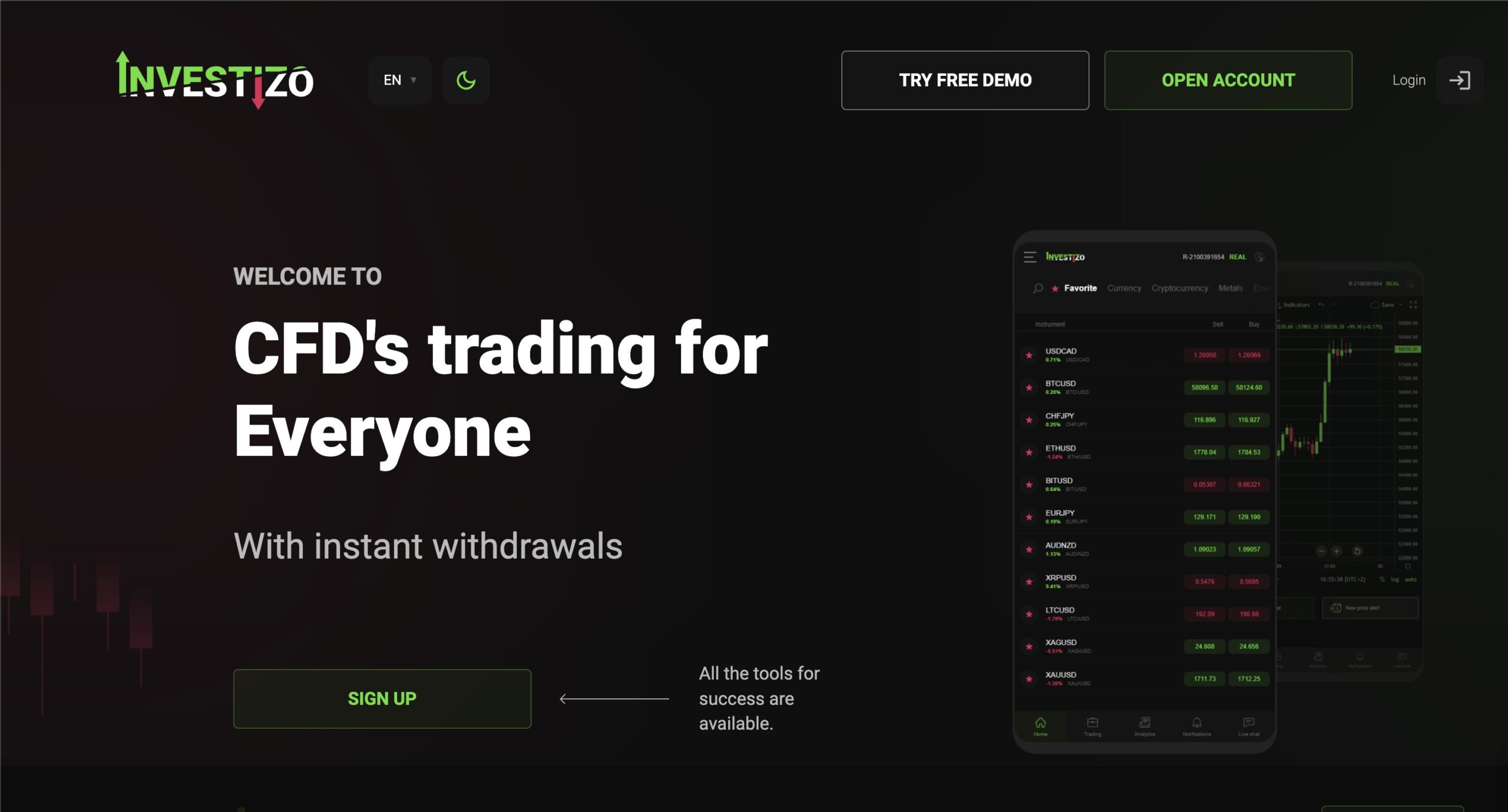
When analyzing https://investizo.com, you are not looking at a simple “legit vs scam” case. You are looking at a high-conflict offshore broker profile where user experiences split sharply between satisfaction and serious allegations of withdrawal delays, account restrictions, and compliance disputes.
This is exactly the type of environment where traders lose money—not because trading fails, but because withdrawal control becomes inconsistent under certain conditions.
1. Trust Signal Reality: Mixed but Risk-Heavy Environment
Public data shows conflicting indicators:
- ScamAdviser suggests the site is potentially legitimate but highlights multiple risk flags such as hidden ownership and high-risk financial services exposure
- Trustpilot shows a mixed rating profile with both strong praise and serious accusations of scam behavior and withdrawal refusal
User reports include:
- Successful trading experiences and fast withdrawals (positive side)
- Withdrawal delays, account freezes, and profit disputes (negative side)
- Claims of “risk checks” or “technical violations” used during withdrawal requests
Now here is the key analytical point:
A split reputation is not neutral.
It is a signal of inconsistent enforcement behavior across users or account stages.
2. Regulation Structure: Offshore + Weak Enforcement Risk
Investizo operates from an offshore jurisdiction structure (commonly St. Vincent & Grenadines-style registration is listed in public data and reviews)
Key implications:
- No Tier-1 regulator (FCA, ASIC, CySEC) overseeing client protection
- No strong investor compensation scheme
- No binding external arbitration for disputes
- Broker retains full internal control over compliance decisions
This creates a structural imbalance:
If regulation is weak, then withdrawal enforcement becomes internal policy-driven, not externally enforced.
And internal policy always favors the platform during disputes.
3. Withdrawal Complaints: The Real Risk Layer
Across Trustpilot and user reviews, the most repeated issues include:
- Withdrawals stuck in “processing” for extended periods
- Requests for additional verification after profit is made
- Accounts flagged for “risk checks” or “technical overlap”
- Profit cancellations labeled as “rule violations”
- Payment delays attributed to third-party processors
One recurring pattern is especially important:
Initial withdrawals often succeed, but larger or later withdrawals trigger friction.
This is a classic risk structure seen in offshore brokers:
- Entry = smooth
- Trading = functional
- Exit at scale = conditional
That asymmetry is where real financial exposure appears.
4. The “Compliance Trigger After Profit” Pattern
User complaints show a repeated sequence:
- Account opens and deposits are accepted normally
- Trading proceeds without major interruption
- Small withdrawals may succeed
- Profits increase or larger withdrawal is requested
- Account enters compliance or security review
- Withdrawal is delayed, partially blocked, or re-verified
Common explanations include:
- “Multiple account connection detected”
- “Risk-free trading pattern violation”
- “Additional documentation required”
- “Payment processor delays”
These mechanisms may be legitimate in regulated environments.
But in weak offshore systems, they become flexible enforcement tools applied selectively at exit stage.
That is the key risk distinction.
5. Trustpilot Reality: Both Sides Exist — That Matters
Investizo has a large volume of reviews, and sentiment is split:
Positive claims:
- Fast deposits and withdrawals for some users
- Responsive support in certain cases
- Competitive trading conditions
- Report A Scam Now
Negative claims:
- “Scam broker holding funds” allegations
- Long withdrawal delays or cancellations
- Account restrictions during profit phases
This duality is important:
In high-risk broker ecosystems, early users often report smooth experiences, while later-stage users encounter friction when capital increases.
That creates a time-based risk curve, not a uniform experience.
6. Offshore Broker Pattern: Why Problems Cluster at Withdrawal Stage
Across many offshore brokers (including patterns seen in similar platforms), the lifecycle looks like this:
- Stage 1: Marketing + onboarding trust building
- Stage 2: Trading engagement and small wins
- Stage 3: Scaling deposits due to confidence
- Stage 4: Withdrawal request introduces friction
- Stage 5: Compliance justification or delays
This is not proof of fraud by itself.
But it is a structural pattern of control asymmetry, where:
- Deposits are unconditional
- Withdrawals are conditional
And conditional withdrawal systems always increase user risk exposure.
7. Psychological Trap: How Users Get Locked In
The biggest danger is not technical—it is behavioral escalation:
- Early success builds confidence
- Small withdrawals reinforce trust
- Users increase account size
- Emotional attachment grows with profit numbers
- Withdrawal delays are rationalized
- Risk signals are ignored to avoid “losing gains”
At that point, the user is no longer evaluating risk objectively—they are negotiating with system friction.
That is where most capital loss happens in offshore brokerage environments.
8. Investor Protection Framework (Critical Discipline Rules)
If interacting with platforms like investizo.com, risk discipline is essential:
- Always test withdrawal before scaling deposits
- Never keep large balances on-platform
- Withdraw profits regularly instead of compounding indefinitely
- Keep full records of chats, transactions, and withdrawal requests
- Treat “compliance review” as a risk trigger, not routine
- Exit immediately at first unexplained delay
- Avoid bonus schemes tied to withdrawal restrictions
These are not suggestions—they are survival rules in offshore trading environments.
9. The Only Question That Actually Matters
Forget ratings. Forget marketing. Forget trading conditions.
Ask this:
If my account is frozen tomorrow, who can force them to release my funds?
If the answer is:
- The broker itself
- Offshore regulator with limited enforcement
- Internal compliance team
Then there is no external guarantee of fund recovery.
And without external enforcement, custody becomes permission-based.
Final Verdict: Is Investizo.com Safe?
Investizo.com is not a straightforward scam label case. It is a high-risk offshore brokerage environment with strong mixed signals and documented withdrawal dispute patterns.
Strengths:
- Many users report successful trading and withdrawals
- Active platform with long operational presence
- Functional trading infrastructure
Risks:
- Offshore regulatory structure with weak enforcement
- Significant withdrawal complaint volume
- Profit-related account review patterns
- Inconsistent user experience at exit stage
So the correct classification is:
High-risk broker with inconsistent withdrawal enforcement depending on user profile, timing, and account conditions.
Stay Away Conclusion
The most dangerous misconception in trading is believing that smooth deposits and positive reviews guarantee safety.
In reality:
- Entry systems are optimized for trust
- Trading systems are optimized for engagement
- Exit systems reveal true control dynamics
With investizo.com, the contradiction between strong user satisfaction and serious withdrawal complaints creates a system where risk is not constant—it is triggered at the point of exit.
And in finance, the only risk that truly matters is simple:
What happens when you try to get your money back.