
Global Exchange Limited (globalexchangeltd.com) calls itself an “AI-driven cryptocurrency investment” firm and sells plans paying up to 28% a day. New Zealand’s Financial Markets Authority warned about it on 6 February 2026. The domain was registered on 16 December 2025 — about nine and a half months ago.
Global Exchange Limited
globalexchangeltd.com
SCAM BROKER
- Website
- globalexchangeltd.com
- Plans
- 2.5%, 8%, 16% and 28% a day for 4 days
- Referral
- 10% + 5% second-line bonus
- Header claims
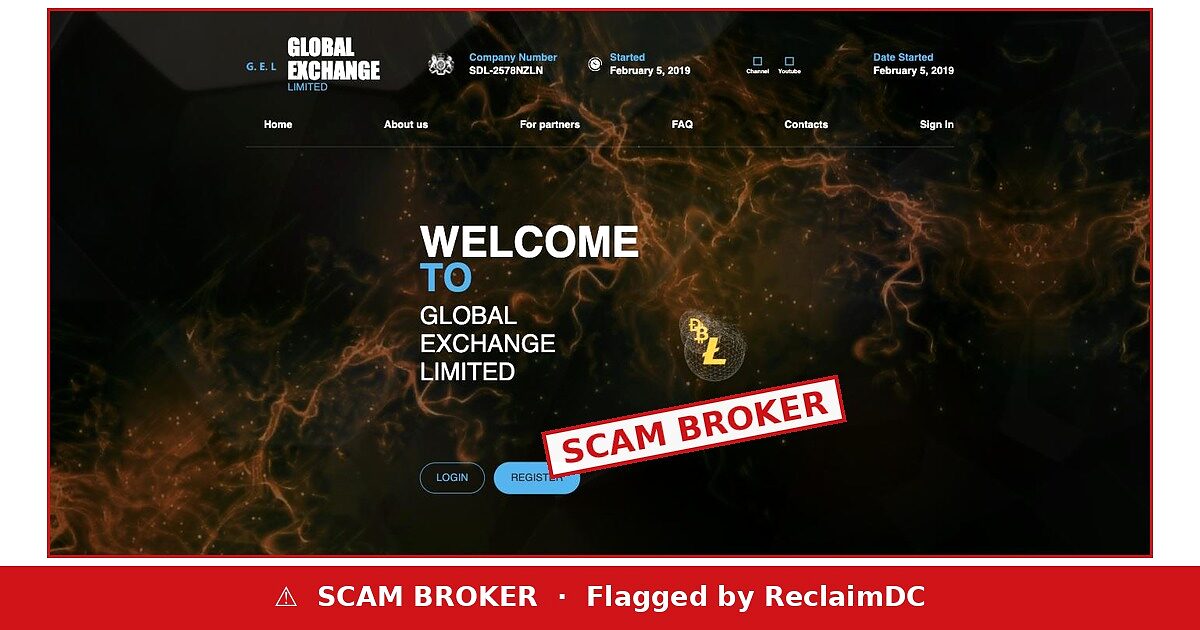
- “Company Number SDL-2578NZLN”; started 5 February 2019
- Warning
- FMA (New Zealand), 6 February 2026
- Domain registered
- 16 December 2025 — about 9.5 months old
The plan table
Starter pays 2.5% a day for 4 days from $100, Leader 8% from $5,000, Premium 16% from $20,000 and Maximum 28% from $50,000. A real investment cannot promise any fixed daily return, let alone 28% — that is more than doubling your money in four days.
A company number that does not exist
The header shows a royal-style crest beside “Company Number SDL-2578NZLN” and “Started February 5, 2019”. It is not the format of a UK or New Zealand company number, and the domain was registered in December 2025. The badge is decoration.
⚠ Verified evidence
- NZ FMA warning, 6 February 2026.
- Plans paying up to 28% a day.
- Fake-looking company number and a 2019 start date.
- Two-level referral bonuses.
Did Global Exchange Limited cost you money or time?
Tell us what happened on our short complaint form — it goes straight to our support team, nothing to download, and we reply personally.
✎ File a complaint about Global Exchange Limited
Include the website, the dates, the amounts and how you paid. Screenshots help.
Paid to recruit
A 10% referral bonus plus 5% on a second line rewards you for bringing in friends. In these schemes, recruits’ deposits are what pay the earlier “profits”.
If money has gone to Global Exchange Limited
- Do not pay any “tax”, “unlock” or “verification” fee Global Exchange Limited asks for — those charges never release a balance.
- Ignore cold calls promising to get your Global Exchange Limited money back for a fee.
- File a report with your local police or national fraud line and keep the reference number.
- If Global Exchange Limited had you install screen-sharing software, delete it and run a security scan.
- Reset your email and banking passwords if Global Exchange Limited ever saw your screen.
- Ask your bank’s fraud team to recall the payment to Global Exchange Limited and to flag the receiving account.
How to verify Global Exchange Limited in two minutes
The quickest test is the FSPR (Financial Service Providers Register) and the FMA’s warnings list: search “Global Exchange Limited” and, separately, globalexchangeltd.com. A WHOIS or RDAP lookup on globalexchangeltd.com shows the registration date: 16 December 2025 about 9.5 months old. Being on the FSPR alone is not a licence — the FMA has warned about firms that use it that way. No result, or a result with a different website, means no licence for this site.
The verdict: Global Exchange Limited is a daily-return scheme with a made-up company number. The FMA has warned about it. Do not deposit.
Sources, checked 2 October 2026: FMA (New Zealand) warning via IOSCO I-SCAN (6 February 2026) · RDAP registration record for globalexchangeltd.com · the live page at globalexchangeltd.com, read in full. Warnings come from regulators, not courts. General information, not investment advice.
Rechecked on 17 November 2026
On 17 November 2026 globalexchangeltd.com was still online, under the page title “GLOBAL EXCHANGE LIMITED”. The domain globalexchangeltd.com was registered on 16 December 2025. It is registered only until 16 December 2026.
How to check a warning from the FMA
New Zealand’s Financial Markets Authority publishes warnings about firms and websites that may be scams, and the Financial Service Providers Register shows who is registered to offer financial services. Registration on that register is not the same as being licensed, so check both. If a firm claims a licence from another country, check that regulator’s own register too, and confirm the website address matches. Report the site to the FMA and to your bank.
If you already paid
- Stop all further payments, including any “fee”, “tax” or “release charge”.
- Write down every wallet address you sent crypto to and the transaction hash for each transfer.
- If you bought the crypto through an exchange, report the transfers to that exchange’s support and fraud team.
- Report card and bank payments that funded the purchases to your bank as fraud.
- Report the site to the regulator named above and to the police.
- Be wary of anyone who contacts you offering to recover the funds for an upfront fee.