
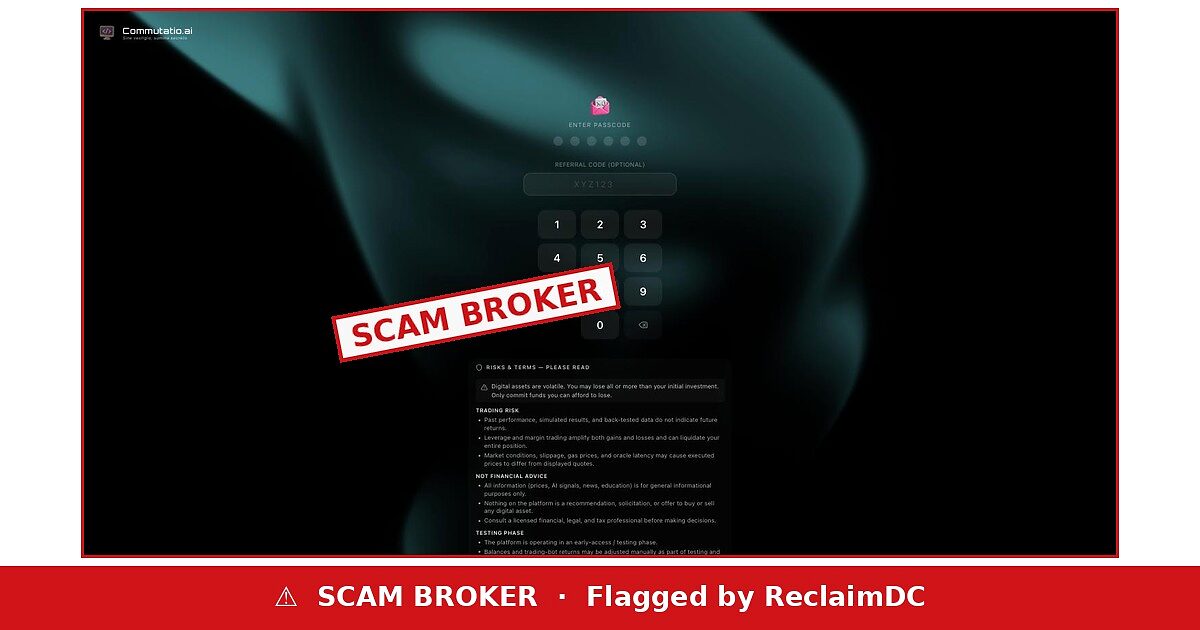
Commutatio.ai sells “AI-assisted perpetual futures trading and crypto swap”, but its front page is a locked keypad. Canada’s British Columbia Securities Commission (BCSC) warned about it on 30 July 2026. Its domain, commutatio.ai, was registered on 17 December 2025 — about nine months ago.
Commutatio.ai
commutatio.ai · invitation-only crypto futures platform
SCAM BROKER
- Website
- commutatio.ai
- Domain registered
- 17 December 2025 (NameCheap)
- Domain age
- About 9 months
- Regulator warning
- BCSC (British Columbia), 30 July 2026
- Access
- Passcode + optional referral code
- Licence
- None shown
‘Without a trace, in utmost secrecy’
The logo carries the Latin motto “Sine vestigio, summa secreto” — roughly “without a trace, in utmost secrecy”. Below it is a six-digit passcode pad and a referral-code box. Entering, the page says, means you “agree to our NDA, Terms of Service, and Privacy Policy”. No legitimate trading venue asks investors to sign a non-disclosure agreement to see it.
Returns that can be ‘adjusted manually’
Its own terms say the platform is “operating in an early-access / testing phase” and that “balances and trading-bot returns may be adjusted manually as part of testing and product iteration.” In plain words: the numbers in your account are whatever the operator decides.
⚠ Verified evidence
- The BCSC warned about Commutatio.ai on 30 July 2026 (listed on IOSCO I-SCAN).
- RDAP shows commutatio.ai was registered on 17 December 2025.
- Access requires a passcode and agreeing to an NDA.
- Its terms say balances and bot returns “may be adjusted manually”.
Did Commutatio.ai cost you money or time?
Tell us what happened on our short complaint form — it goes straight to our support team, nothing to download, and we reply personally.
✎ File a complaint about Commutatio.ai
Include the website, the dates, the amounts and how you paid. Screenshots help.
Invite-only by design
A passcode and referral system keeps outsiders — and regulators — out, and makes victims recruit each other. The site logs “referral codes, IP address, and device metadata” for “attribution”.
Who is being targeted
Invite-only platforms spread through private chats, trading groups and friends. If someone gives you a code, ask them who licenses the platform. Here there is no answer.
What to do after paying Commutatio.ai
- A withdrawal “fee” from Commutatio.ai is the next stage of the scam, not a step towards your money.
- Save the trail: payment receipts, wallet addresses, the Commutatio.ai dashboard screenshots and every chat.
- Card payment? Request a chargeback for “services not provided” as soon as possible.
- Capture the Commutatio.ai balance page and trade history today — these sites vanish.
The verdict: Commutatio.ai hides behind a passcode and an NDA and reserves the right to change your balance by hand. The BCSC has warned about it. Do not deposit.
Sources, checked 30 September 2026: British Columbia Securities Commission warning via IOSCO I-SCAN (30 July 2026) · RDAP registration record for commutatio.ai · the live page at commutatio.ai, read in full
Rechecked on 17 November 2026
On 17 November 2026 commutatio.ai was still online, under the page title “Commutatio.ai — AI-Assisted Perpetual Futures Trading & Crypto Swap”.
How to check a warning from the BCSC
The British Columbia Securities Commission publishes investment caution lists, and anyone trading or advising in Canada must be registered. Search the name on aretheyregistered.ca. If the firm is not there, it is not registered. Report the site to the BCSC and your bank.
Sites like this are rarely found by chance. Most victims arrive through a social media advert, a message from someone they met online, or a call after filling in a form. If someone directed you to this platform, the messages they sent are evidence. Keep them, and do not let anyone install remote-access software on your phone or computer.
If you already paid
- Stop all further payments, including any “fee”, “tax” or “release charge”.
- Write down every wallet address you sent crypto to and the transaction hash for each transfer.
- If you bought the crypto through an exchange, report the transfers to that exchange’s support and fraud team.
- Report card and bank payments that funded the purchases to your bank as fraud.
- Report the site to the regulator named above and to the police.
- Be wary of anyone who contacts you offering to recover the funds for an upfront fee.
Records to keep
Keep screenshots of the dashboard and your balance, the website address, every email and chat, phone numbers that called you, and every bank, card or crypto payment with dates and amounts. For crypto, keep wallet addresses and transaction hashes. These are the first things your bank, the police and the regulator will ask for.