
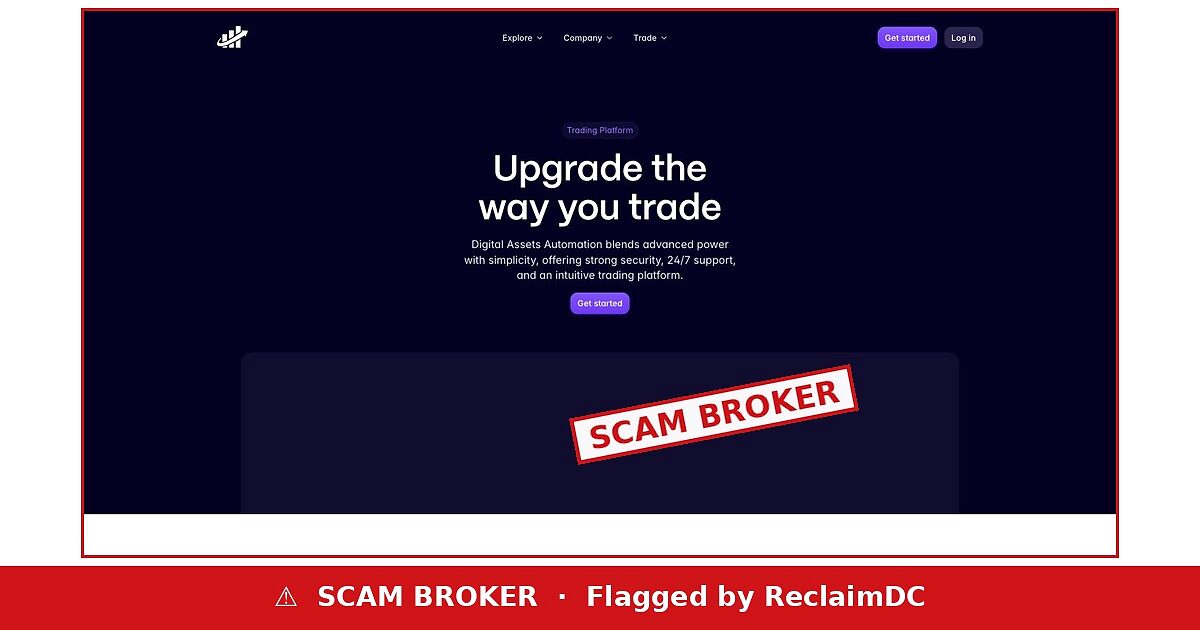
Digital Assets Automation promises one-click copy trading, “up to 100x leverage”, staking and even real estate. Greece’s Hellenic Capital Market Commission (HCMC) warned about it on 24 July 2026. Its domain, digitalassetsautomation.net, was registered on 9 March 2025.
Digital Assets Automation
digitalassetsautomation.net · copy trading and crypto platform
SCAM BROKER
- Website
- digitalassetsautomation.net
- Domain registered
- 9 March 2025 (NameCheap)
- Domain age
- About 1 year 6 months
- Regulator warning
- HCMC (Greece), 24 July 2026
- Company named
- “Digital Assets Automation Ltd” — no country
- Leverage
- Up to 1:100
Prices from another day
On 30 September 2026 its market table showed Bitcoin at 113,272.00 and Ether at 4,460.42. Live feeds that day showed Bitcoin near $84,000. The same table shows “USD 1.00, +0.98%” — the US dollar rising against itself.
Somebody else’s small print
The footer disclaimer talks about “Margin Loan Rates”, “security futures” and a “Security Futures Risk Disclosure Statement” — wording from a large US brokerage. The site offers none of those products and holds no US registration.
⚠ Verified evidence
- The HCMC (Greece) warned about digitalassetsautomation.net on 24 July 2026 (IOSCO I-SCAN).
- RDAP shows the domain was registered on 9 March 2025.
- Its table showed Bitcoin at 113,272 when live markets showed about 84,000.
- No licence, address or company registration is given.
Did Digital Assets Automation cost you money or time?
Tell us what happened on our short complaint form — it goes straight to our support team, nothing to download, and we reply personally.
✎ File a complaint about Digital Assets Automation
Include the website, the dates, the amounts and how you paid. Screenshots help.
A Ltd with no country
“© 2026 Digital Assets Automation Ltd.” is the only company detail: no country of registration, no number, no address, no regulator.
Who is being targeted
Greece’s regulator flagged it, but the site runs in dozens of languages through a translation widget. It is built to catch anyone searching for copy trading.
Already paid Digital Assets Automation?
Send nothing more to Digital Assets Automation — not even to “upgrade” or “unlock” the account. Turn on two-factor login for your bank and email today. Recovery offers that arrive after you lose money to Digital Assets Automation are usually run by the same people.
- Phone your bank or card issuer and ask about a chargeback or a recall of the transfer.
- Remove any remote-desktop app Digital Assets Automation set up on your phone or PC.
The verdict: Digital Assets Automation shows prices that are not real, borrows a US broker’s disclaimer and has no licence. Greece’s regulator has warned about it. Do not deposit.
Sources, checked 30 September 2026: Hellenic Capital Market Commission via IOSCO I-SCAN (24 July 2026) · RDAP registration record for digitalassetsautomation.net · the live page, read in full
Rechecked on 17 November 2026
By 17 November 2026 digitalassetsautomation.net no longer loaded.
How to check a regulator warning yourself
Before depositing, search the firm’s exact name and web address on your national regulator’s register and warning list, such as the FCA in the UK, ASIC in Australia or the SEC and FINRA in the US. A real firm names its legal entity, address and licence number, and those details match the regulator’s record. If any of that is missing, do not send money. Report losses to your bank and to the police or national fraud reporting service.
A site going offline after a regulator warning rarely means the people behind it have stopped. The same operators often relaunch with a new name, a new domain and the same design, and contact former clients to move their “balance” to the new platform. Treat any such offer as a continuation of the same scam.
Even with the site gone, a bank can sometimes still help, especially with recent card payments or transfers to accounts in the UK or EU. Report every payment as fraud as soon as possible, give the bank the website address and the dates, and ask specifically about a chargeback or a recall.
If you already paid
- Stop all further payments, including any “fee”, “tax” or “release charge”.
- Write down every wallet address you sent crypto to and the transaction hash for each transfer.
- If you bought the crypto through an exchange, report the transfers to that exchange’s support and fraud team.
- Report card and bank payments that funded the purchases to your bank as fraud.
- Report the site to the regulator named above and to the police.
- Be wary of anyone who contacts you offering to recover the funds for an upfront fee.
Records to keep
Keep screenshots of the dashboard and your balance, the website address, every email and chat, phone numbers that called you, and every bank, card or crypto payment with dates and amounts. For crypto, keep wallet addresses and transaction hashes. These are the first things your bank, the police and the regulator will ask for.