
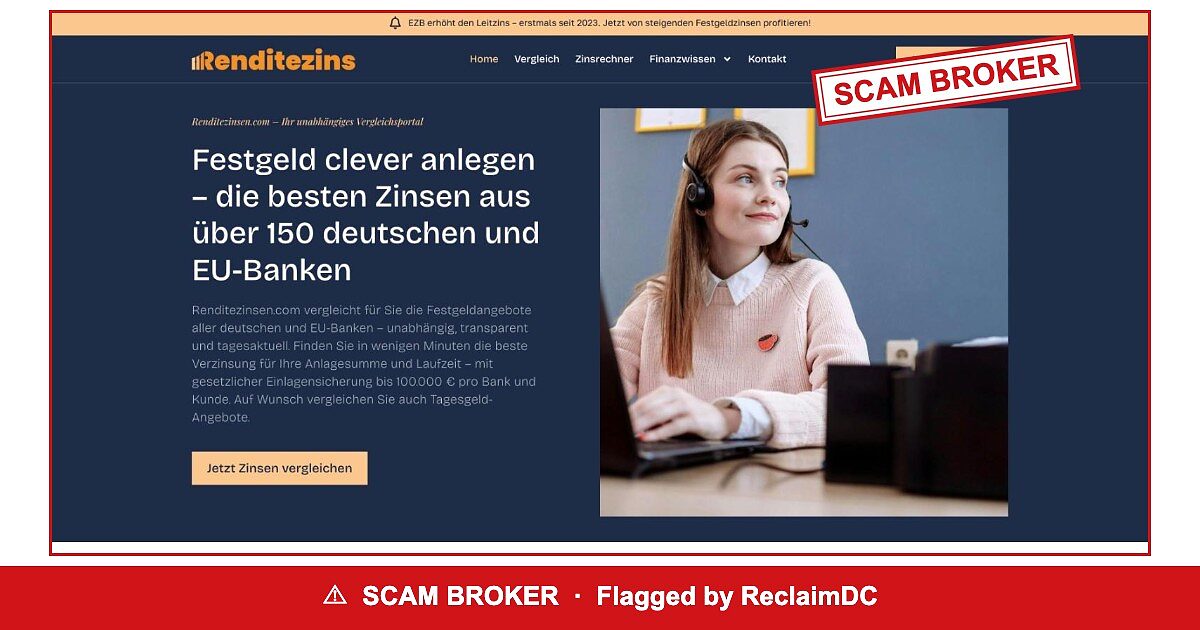
Renditezins (renditezinsen.com) presents itself as a fixed deposit comparison site that compares more than 150 German and EU banks, with statutory deposit protection up to 100,000 euro per bank. It claims to be run by a German asset management company. BaFin warned on 5 October 2026 that the site offers fake fixed term deposits and falsely claims BaFin supervision.
Before you open any fixed deposit
- Open the account directly on the bank’s own website.
- Check that the IBAN belongs to that bank, in your name.
- Search the BaFin company database for the exact name.
- Never transfer to a middleman for a deposit.
Our verdict: a fake fixed deposit site with a false BaFin claim. Treat Renditezins as a scam.
What Renditezins tells you
Renditezins
renditezinsen.com
BAFIN WARNING
- Offer: Festgeld and Tagesgeld comparison
- Banks compared: over 150
- Deposit protection: up to 100,000 euro
- Hook: ECB rate rise headline
- Domain registered: 22 July 2026
The site opens with a headline about the European Central Bank raising rates for the first time since 2023, and invites you to lock in higher fixed deposit rates now. Real comparison sites send you to the bank itself. Fake ones ask you to open the deposit through them and pay into an account they control.
Paid into a Renditezins deposit?
Tell us which account you paid and when. We will look at it with you and say plainly what can still be done.
Nobody can promise a recovery. Be careful with anyone who does.
Borrowed names
Sites in this scheme often use the name of a real registered company to look trustworthy. If a firm on the site has a real register entry, that does not mean it runs the site. BaFin has said plainly that this one is fake.
Why fake deposit sites work so well
Fixed deposits feel like the safest product there is. People who would never buy crypto will open a Festgeld account for a slightly better rate, especially when a site mentions deposit protection and a rate rise. That trust is exactly what Renditezins borrows. The rate offered is usually a little above the market, not wildly so, which makes it believable.
The money, though, goes to an account controlled by the operators, often abroad or held by a money mule. Statements and interest notices may look real for months. The loss only shows when the deposit is due back. If you used Renditezins, call the bank whose name you were shown, using a number from its own website, and ask whether an account in your name really exists.
Sources: BaFin consumer warning on renditezinsen.com (5 October 2026); renditezinsen.com (checked 31 October 2026); RDAP record. General information only.