
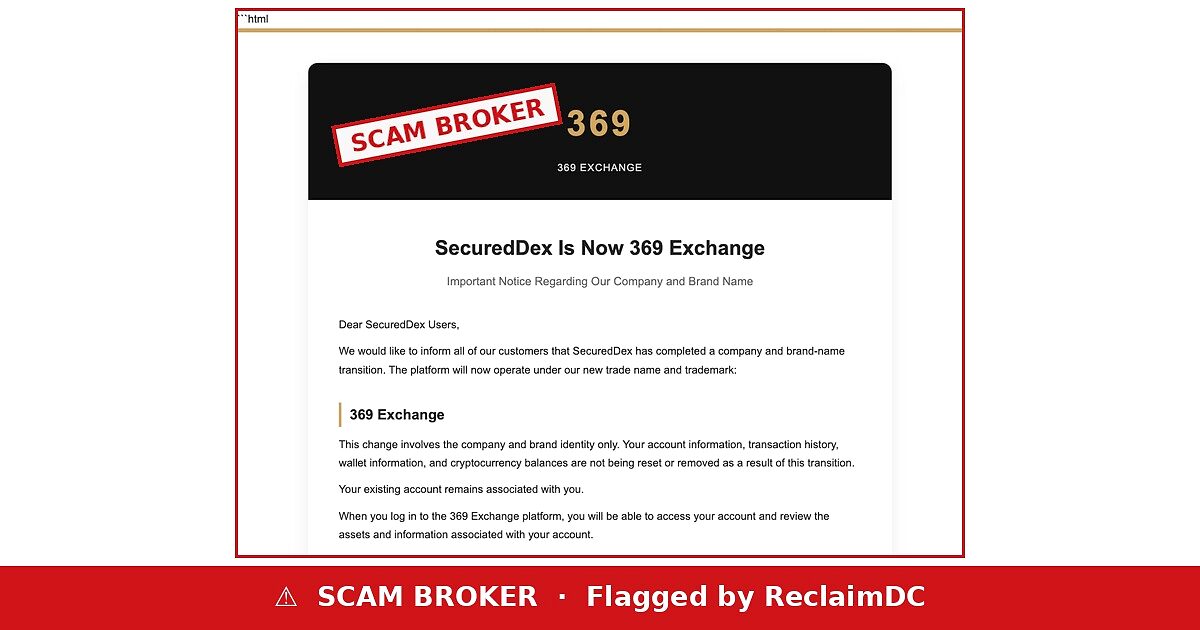
SecuredDex (secureddex.com) has replaced its homepage with a notice: “SecuredDex Is Now 369 Exchange” — “YOUR ASSETS ARE NOT LOST”. Sweden’s Finansinspektionen warned about SecuredDex on 1 April 2026. The domain was registered on 10 September 2024 — about two years ago.
SecuredDex
secureddex.com
SCAM BROKER
- Website
- secureddex.com
- New name
- 369 Exchange
- Homepage
- Brand-change notice only
- Company
- None named
- Regulator
- Finansinspektionen (Sweden), 1 April 2026
- Domain registered
- 10 September 2024 — about 2 years old
The rebrand move
When a platform is named by a regulator, it often reappears under a new name and tells existing clients to log in there. The notice says your “cryptocurrency balances are not being reset or removed” and that you can see them on the 369 Exchange platform.
A balance on a screen is not money
The notice promises you will “review the assets and information associated with your account”. Seeing a balance does not mean you can withdraw it. The next step on such platforms is usually a fee to unlock it.
⚠ Verified evidence
- Sweden’s Finansinspektionen warned about SecuredDex on 1 April 2026.
- Homepage now says “SecuredDex Is Now 369 Exchange”.
- “YOUR ASSETS ARE NOT LOST” reassurance notice.
- Stray ““`html” text; no company or licence.
Did SecuredDex cost you money or time?
Tell us what happened on our short complaint form — it goes straight to our support team, nothing to download, and we reply personally.
✎ File a complaint about SecuredDex
Include the website, the dates, the amounts and how you paid. Screenshots help.
Written in a hurry
The top of the page still shows the text ““`html” — code formatting pasted straight onto the live site. There is no company name, address or licence on the notice.
What not to do
Do not open a new account on 369 Exchange to “move” your funds, and do not pay any migration, tax or verification fee.
Your own check on SecuredDex
Open FI’s company register at fi.se and type the exact name “SecuredDex”, then search again for secureddex.com. Check whether the address on the site matches a real office in a map search. FI’s warning list names unauthorised firms that target Swedish investors. A WHOIS or RDAP lookup on secureddex.com shows the registration date: 10 September 2024.
Lost money with SecuredDex?
Freeze contact about new deposits; SecuredDex will push hardest right now. Ask your bank’s fraud team to recall the payment to SecuredDex and to flag the receiving account. Record the SecuredDex login page and your balance with dated screenshots.
- Export your WhatsApp or Telegram chats with SecuredDex and keep every receipt.
- Use Sweden’s Finansinspektionen’s online form to report SecuredDex.
The verdict: SecuredDex was warned about by Sweden’s regulator and now sends clients to a new name. Treat 369 Exchange as the same operation and do not pay to recover a balance.
Sources, checked 1 October 2026: Finansinspektionen (Sweden) warning via IOSCO I-SCAN (1 April 2026) · RDAP registration record for secureddex.com · the live page at secureddex.com, read in full. A regulator’s warning is an alert, not a conviction. For information only — not financial advice.
Rechecked on 17 November 2026
On 17 November 2026 secureddex.com was still online, under the page title “SecuredDex is now 369 Exchange”.
How to check a Finansinspektionen warning yourself
Sweden’s Finansinspektionen publishes investor alerts about firms offering services without authorisation and keeps a company register of licensed firms. Search the exact name and web address. Report the site to Finansinspektionen and your bank.
A site that stays online after a regulator warning is still taking sign-ups. Regulators can warn the public and, in some countries, order internet providers to block a site, but they cannot always take it down. That is why searching a platform’s exact name and web address on the regulator’s own list, before you deposit, matters more than anything the site says about itself.
If you already paid
- Stop all further payments, including any “fee”, “tax” or “release charge”.
- Write down every wallet address you sent crypto to and the transaction hash for each transfer.
- If you bought the crypto through an exchange, report the transfers to that exchange’s support and fraud team.
- Report card and bank payments that funded the purchases to your bank as fraud.
- Report the site to the regulator named above and to the police.
- Be wary of anyone who contacts you offering to recover the funds for an upfront fee.