
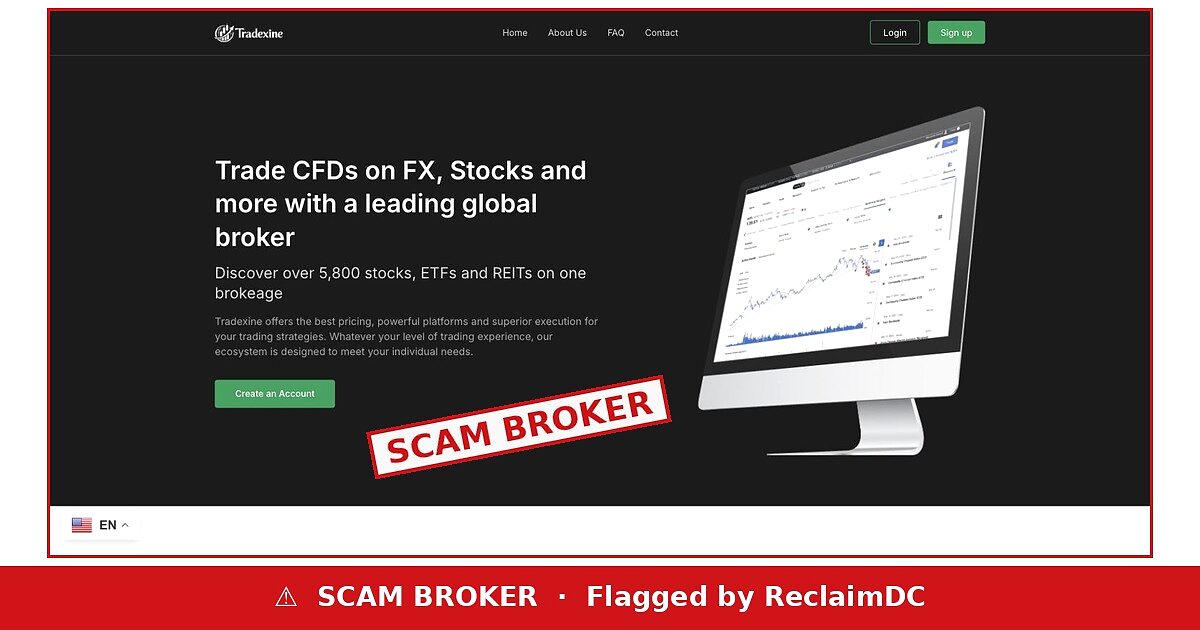
Tradexine (tradexine.com) says it is “FCA authorised” and shows headline figures of $13.8B equity capital and 2.05M client accounts. The British Columbia Securities Commission warned about it on 25 June 2026. The domain was registered on 6 March 2026 — about seven months ago.
Tradexine
tradexine.com
SCAM BROKER
- Website
- tradexine.com
- Claims
- FCA authorised; $13.8B equity capital; 2.05M accounts
- Minimum
- $1,000
- Twin site
- tellergain.com (identical text)
- Warning
- BCSC (Canada), 25 June 2026
- Domain registered
- 6 March 2026 — about 7 months old
An FCA claim you can test
The page says “FCA authorised — We are authorised and regulated”. There is no firm reference number. Every UK-authorised firm has one, and it appears on the public FCA register. Without it the claim is just words.
Figures from somebody else’s annual report
“$13.8B Equity Capital*, $8.5B Excess Regulatory Capital*, 2.05M Client Accounts*, 1.95M Daily Avg Revenue Trades*” — the format, down to the asterisks, is lifted from the investor page of a large listed broker. A seven-month-old domain does not hold billions in capital.
⚠ Verified evidence
- BCSC warning, 25 June 2026.
- Claims FCA authorisation with no reference number.
- Copies a listed broker’s $13.8B capital format.
- Twin of Teller Gain, warned the same day.
Did Tradexine cost you money or time?
Tell us what happened on our short complaint form — it goes straight to our support team, nothing to download, and we reply personally.
✎ File a complaint about Tradexine
Include the website, the dates, the amounts and how you paid. Screenshots help.
Same words as Teller Gain
Tradexine shares its text with tellergain.com, including the typo “one brokeage” and “Trusted by 1+ million users”. BCSC warned about both on the same day. They are one operation under two names.
Checking Tradexine yourself
Go to the BCSC’s investment caution list and the national CSA registration search (aretheyregistered.ca). Enter tradexine.com first, then the trading name “Tradexine”. In Canada, anyone selling investments must show up on aretheyregistered.ca. Then compare the domain date (6 March 2026) with the history the site claims. A match on name alone is not enough — the website on the entry must be tradexine.com.
Lost money with Tradexine?
- Stop all further deposits to Tradexine, whatever the account manager promises.
- Crypto transfers: give the exchange you used the receiving address and the TXID so it can be flagged.
- Ask your bank’s fraud team to recall the payment to Tradexine and to flag the receiving account.
- Report Tradexine to the BCSC — they issued the warning and collect victim reports.
The verdict: Tradexine borrows a regulator’s name and another broker’s numbers. Do not deposit.
Sources, checked 2 October 2026: BCSC (Canada) warning via IOSCO I-SCAN (25 June 2026) · RDAP registration record for tradexine.com · the live page at tradexine.com, read in full. This reflects public regulator warnings; no court has ruled. Not financial advice.
Rechecked on 17 November 2026
On 17 November 2026 tradexine.com returned a server error and did not show the platform. The domain tradexine.com was registered on 6 March 2026, and its registration record last changed on 5 September 2026.
How to check a warning from the BCSC
The British Columbia Securities Commission publishes investment caution lists, and anyone trading or advising in Canada must be registered. Search the name on aretheyregistered.ca. If the firm is not there, it is not registered. Report the site to the BCSC and your bank.
A site going offline after a regulator warning rarely means the people behind it have stopped. The same operators often relaunch with a new name, a new domain and the same design, and contact former clients to move their “balance” to the new platform. Treat any such offer as a continuation of the same scam.
Even with the site gone, a bank can sometimes still help, especially with recent card payments or transfers to accounts in the UK or EU. Report every payment as fraud as soon as possible, give the bank the website address and the dates, and ask specifically about a chargeback or a recall.
If you already paid
- Stop all further payments, including any “fee”, “tax” or “release charge”.
- Write down every wallet address you sent crypto to and the transaction hash for each transfer.
- If you bought the crypto through an exchange, report the transfers to that exchange’s support and fraud team.
- Report card and bank payments that funded the purchases to your bank as fraud.
- Report the site to the regulator named above and to the police.
- Be wary of anyone who contacts you offering to recover the funds for an upfront fee.