
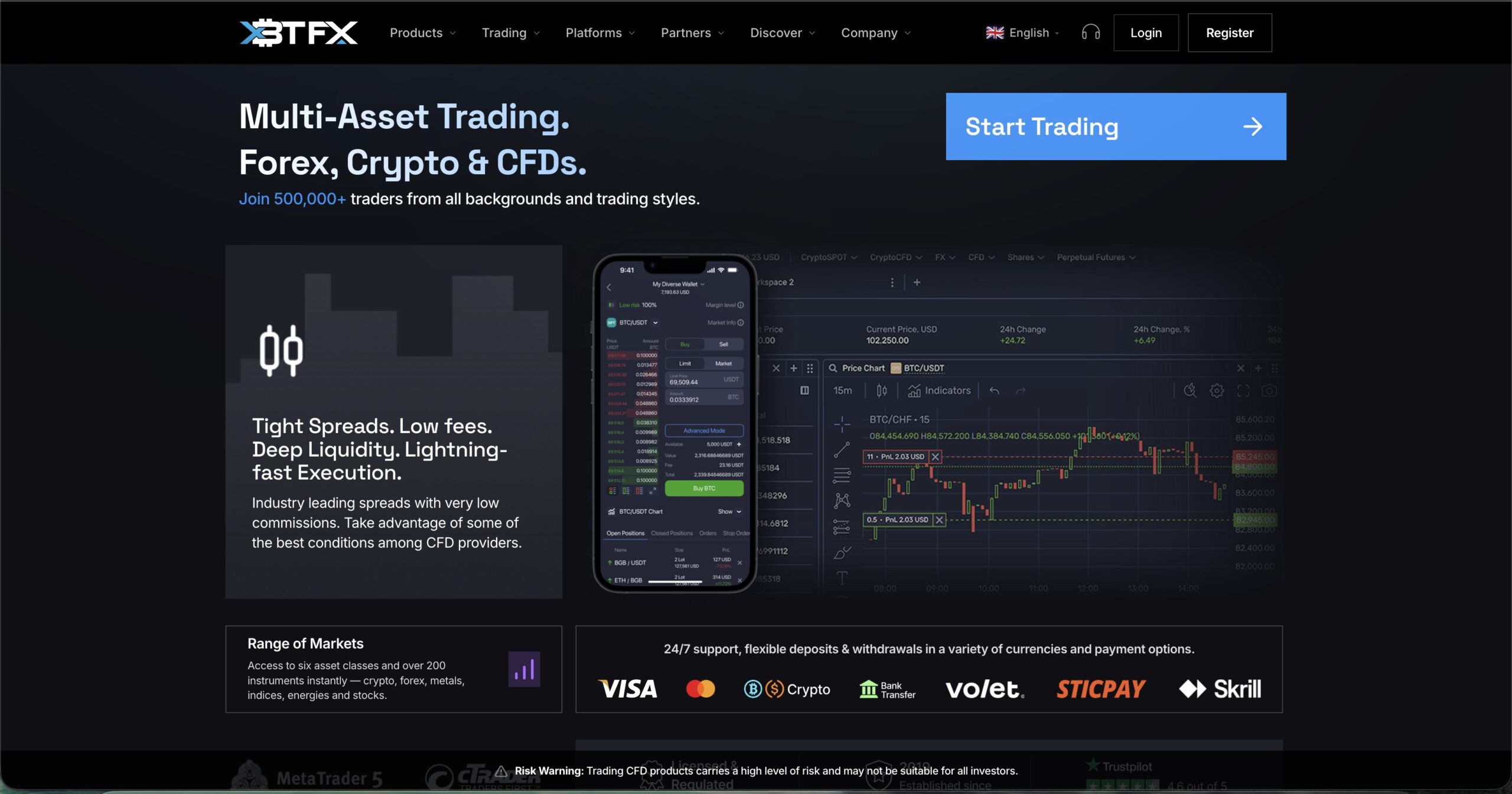
When analyzing https://xbtfx.com, the surface narrative looks reassuring: strong Trustpilot ratings, active trading reviews, claims of fast withdrawals, and a “professional broker” image built around MT4/MT5 and crypto-friendly funding.
But in risk analysis, popularity is not protection.
The real question is not whether users like the platform—but whether it remains reliable when large profits and withdrawal pressure enter the system.
1. Trust Score vs Reality: A Mixed Signal System
At first glance, XBTFX appears heavily rated:
- Trustpilot shows a 4.7–4.8/5 rating range with hundreds of reviews
- Users frequently mention fast support, smooth onboarding, and decent trading conditions
- Some traders report successful withdrawals and stable execution
That sounds strong—but this is where critical thinking is required.
High ratings in offshore broker environments do not automatically equal safety. They often reflect:
- Early-stage user experiences (small deposits, demo trading, initial withdrawals)
- Selective review bias (users who had no issues are more likely to post)
- Platform-dependent experience variance
Now contrast that with regulatory reality.
2. Regulation Gap: The Structural Weak Point
Public broker analysis shows that XBTFX/XBTFX operates without top-tier regulatory oversight (FCA, ASIC, CySEC absent) and is positioned as a crypto-centric offshore broker model .
Key structural implications:
- No strong investor compensation scheme
- Limited external enforcement over disputes
- Broker-controlled compliance decisions
- Weak escalation pathways for withdrawal conflicts
This creates a critical imbalance:
A regulated broker is forced to comply externally.
An offshore broker only complies internally.
That difference determines who has real control over funds.
3. Withdrawal Complaints: Where Risk Actually Appears
Across reviews and forum discussions, XBTFX is often described positively for:
- Execution speed
- Spread competitiveness
- Crypto deposit flexibility
- Support responsiveness
However, even within positive ecosystems, there are recurring caution points:
- Some users report withdrawal delays depending on method or chain
- Confusion around fees and processing routes (crypto-only withdrawals in some cases)
- Limited clarity on formal withdrawal policies and timelines
- Heavy reliance on support intervention rather than automated processing
Now apply a stress test:
A broker is not judged when deposits are flowing.
It is judged when large withdrawals are requested under profit conditions.
That is where friction typically emerges in offshore systems.
4. The “Smooth Until Scale” Pattern
Even in mixed-review brokers like XBTFX, a common structural pattern appears across the industry:
Phase 1: Entry Phase
- Easy onboarding
- Smooth deposits (especially crypto)
- Friendly support
- Stable demo/live environment
Phase 2: Growth Phase
- User begins to scale capital
- Trading profits accumulate
- Platform appears reliable
Phase 3: Exit Pressure Phase
- Larger withdrawals requested
- Additional verification or compliance checks appear
- Processing delays increase
- Support becomes procedural rather than flexible
This is not proof of wrongdoing.
It is a known risk architecture pattern in offshore brokerage systems.
5. Crypto-Centric Model: Convenience vs Control
XBTFX operates heavily on crypto funding systems (BTC, ETH, stablecoins), which creates both advantages and risks:
Advantages:
- Fast deposits
- Global accessibility
- Lower banking friction
Risks:
- Irreversible transfers
- Limited chargeback protection
- Dependence on internal wallet accounting
- Reduced external dispute leverage
This is the critical tradeoff many users underestimate:
Crypto makes entry easier—but exit protection weaker.
6. Psychological Risk: Why Users Miss Early Warning Signs
The biggest failure point is not technical—it is behavioral.
Users typically:
- Trust early positive execution
- Anchor belief on small successful withdrawals
- Increase deposit size gradually
- Interpret delays as “normal broker behavior”
- Continue trading despite unresolved friction
This creates a dangerous bias loop:
“It worked before, so it must be fine.”
In financial risk systems, past success does not guarantee future enforceability.
7. Key Structural Questions You Must Ask
Before trusting any broker like XBTFX, the real evaluation is not marketing—it is enforceability.
Ask:
- Who can legally force withdrawal if disputes occur?
- What regulator can intervene independently?
- Are withdrawal rules fixed or discretionary?
- Can compliance decisions be reversed externally?
- What happens if account freezes during profit periods?
If answers depend on the broker itself, then you are inside a self-governed financial system.
And self-governed systems always carry asymmetric risk.
8. Investor Protection Strategy (Practical Rules)
If exposure already exists or is being considered, discipline is required:
- Start with minimal capital and test withdrawals first
- Never scale deposits before proving exit reliability
- Withdraw profits regularly instead of compounding indefinitely
- Keep full transaction logs and screenshots
- Avoid relying on bonus or promotional leverage systems
- Treat delays as risk signals, not administrative noise
- Exit immediately if withdrawal behavior changes after profit
These rules are not conservative—they are defensive control mechanisms.
Final Verdict: Is XBTFX.com Safe?
Based on available data, XBTFX.com is not a clear-cut scam case, but it operates in a structurally high-risk offshore brokerage category.
Strengths:
- Positive user reviews and active trading feedback
- Reported successful withdrawals for many users
- Functional trading infrastructure
Risks:
- Lack of top-tier regulation
- Crypto-based custody dependency
- Withdrawal policy transparency limitations
- Offshore enforcement environment
The key insight is this:
A platform can function well and still be structurally unsafe.
Safety is not defined by trading experience.
It is defined by withdrawal enforceability under stress.
Stay Away Conclusion
The most dangerous misconception in trading is assuming that smooth deposits and positive reviews equal financial safety.
In reality:
- Entry systems are designed to be frictionless
- Trading systems are designed to feel reliable
- Exit systems reveal true control dynamics
With xbtfx.com, the combination of offshore structure and limited regulatory enforceability means users are ultimately dependent on internal broker policies during withdrawal events.
That is not a neutral risk environment.
It is a controlled access environment.
And in financial systems, control over exit equals control over capital.